

You can transform a quarter-acre into a six-figure cut flower business by stacking high-margin crops like dahlias and ranunculus, selling seed annuals for quick returns, and targeting local florists who pay premium prices. Launch wedding events, design services, and subscription boxes to multiply per-stem revenue. Track profit metrics per crop, optimize your mix quarterly, and scale strategically as demand grows. The path from hobby garden to profitable farm operation involves specific crop choices, pricing strategies, and operational systems that’ll reshape your entire approach.
Key Takeaways
- Grow high-margin specialty flowers like ranunculus, dahlias, and snapdragons with 60-70% profit margins for maximum profitability.
- Use succession planting and intensified spacing in raised beds to multiply stems per square foot and eliminate production gaps.
- Diversify revenue through retail bouquets, subscriptions, wholesale contracts, and event services rather than relying on single sales channels.
- Implement dual-product crops: sell cut flowers plus dahlia tubers or peony roots to transform single plantings into multiple income streams.
- Track profitability by crop and season, targeting 30-60% operating margins and reallocating space to crops exceeding 65-90% gross margins.
Start With High-Margin Dahlias and Ranunculus

Why do so many successful cut flower farms prioritize dahlias and ranunculus?
These crops dominate farm revenue because they deliver exceptional returns. Ranunculus accounts for roughly 30% of overall farm profit and achieves 63% profit margins, while dahlias represent 25% of revenue on focused operations. Together, they generate over 50% of total farm revenue.
You’ll find ranunculus particularly attractive in high tunnels, where net returns reach $5 per square foot. November plantings produce the strongest yields—3.5 to 6.5 stems per plant—significantly outperforming field production’s 1 to 2 stems. Pre-sprouting boosts returns further, increasing net gains from $4.23 to $4.81 per square foot. Applying the Pareto Principle to your crop selection concentrates marketing and sales resources on your highest-earning varieties for streamlined profitability analysis.
Dahlia profitability extends beyond cut flowers through tuber sales, generating substantial secondary income. Single ranunculus harvests can yield $6,180 revenue from 3,100 stems, netting $3,850 after expenses. These crops establish your farm’s financial foundation quickly.
Grow Seed Annuals for Low-cost Entry and Quick Returns

If you’re looking to launch your cut flower farm without substantial upfront capital, seed annuals offer an ideal entry point.
You’ll invest minimally compared to bulbs or perennials, since seeds cost far less than established plants.
Warm-season varieties like sunflowers, zinnias, and celosia germinate and bloom within a single season, enabling rapid revenue generation.
You’ll achieve impressive profit margins—anemones and snapdragons reach around 70%—while cut-and-come-again varieties like Icelandic poppies maximize returns per square foot.
Direct seeding outdoors eliminates the need for protected growing spaces, streamlining your processes and reducing expenses significantly.
Intensifying your planting density on even a small footprint allows you to produce thousands of stems weekly, dramatically improving your fixed-cost ratio.
You’ll also enjoy consistent marketability.
Rudbeckias store three weeks post-harvest, lisianthus bridges seasonal gaps with exceptional vase life, and local premium pricing commands higher florist demand throughout the year.
Build Wedding and Event Revenue to Maximize Per-stem Sales
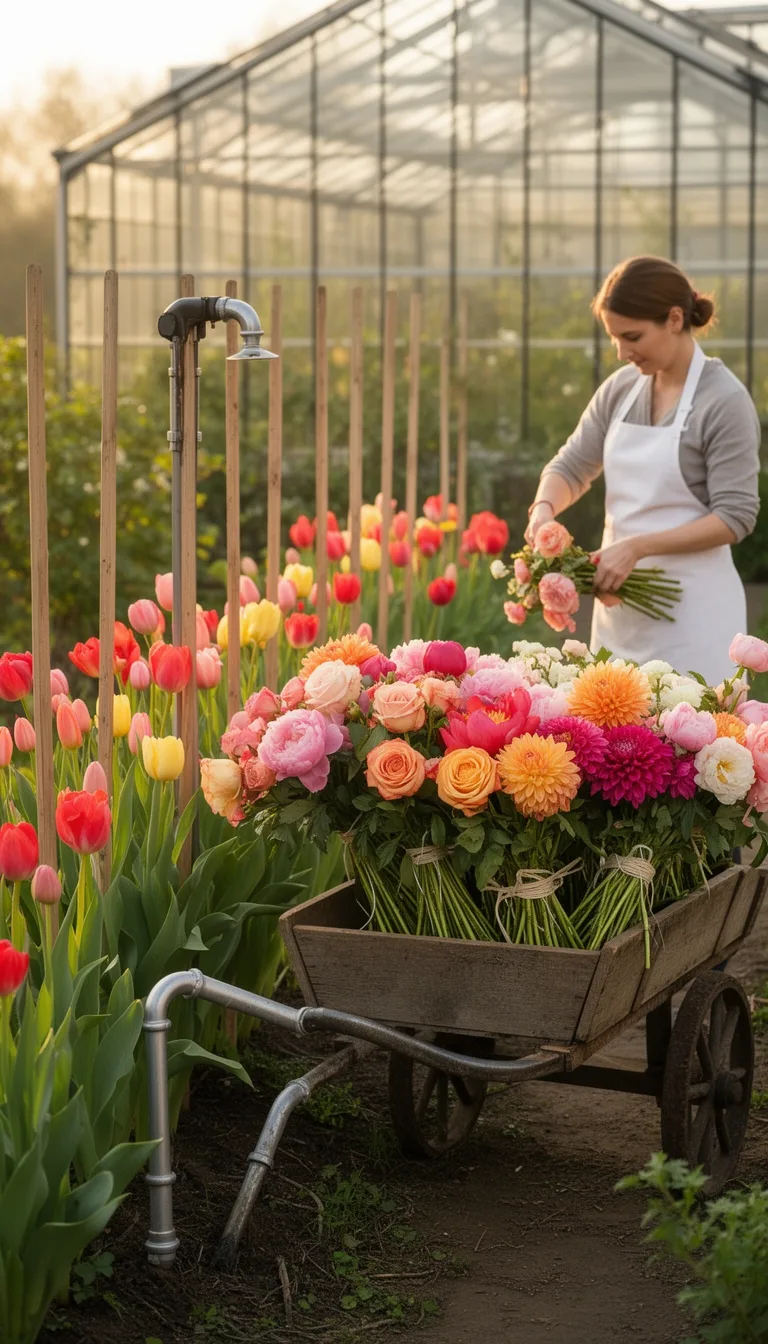
Once you’ve established reliable seed annual production, wedding and event work offers your most lucrative opportunity to amplify per-stem profitability.
You’ll command premium pricing—often double or triple farmers market rates—by bundling stems into arrangements and design services rather than selling individual flowers.
Most operations generate $1,000–$5,000 per wedding, though top performers exceed $10,000 per event.
The key’s managing capacity strategically.
Capping subscriptions and events at sustainable levels prevents burnout while maximizing margins. Diversifying into high-margin ancillary products like bulb and peony root sales creates additional revenue without proportionally increasing labor demands.
Consider pairing high-labor wedding design with lower-intensity revenue streams like bulb sales to balance profitability and workload.
Diversify further through showers, grad parties, and custom orders.
Photography sessions and add-on services supplement core floral income, creating multiple revenue channels from each event.
Target Local Florists Who Pay Premium Prices for Unique Blooms
As your cut flower operation matures, local florists represent your highest-margin wholesale channel—one that’ll reward you for growing specialty varieties that farmers markets can’t absorb.
Florists actively seek inventory differentiation, and you’re positioned to supply it.
Build relationships with 2-3 regional florists who maintain consistent demand year-round. Focus your production strategy on these opportunities:
- Grow specialty varieties like ranunculus, dahlias, and peonies commanding $2.00-$2.50 per stem versus standard zinnias at $1.00-$1.25
- Develop exclusive cultivars that justify premium wholesale rates through limited local supply
- Target pro-cut sunflowers reaching $3.00-$4.00 per stem for florist-specific demand
- Plan inventory around peak seasons—Valentine’s Day and Mother’s Day drive consistent premium pricing
Florists purchasing 4-6 weeks ahead create predictable revenue streams that justify specialty crop investment. Valentine’s Day represents the top holiday for florist sales, making advance planning essential for capturing maximum volume during this peak demand period.
Launch Design Services to Capture Higher-value Orders
Why settle for wholesale stem pricing when you can capture 2.5–3x markup by designing custom arrangements directly for clients? You’ll transform raw stems into high-value experiences that command premium pricing.
| Service | Price Point | Profit Margin |
|---|---|---|
| Wholesale stems | $10–25/bunch | 30–40% |
| Retail bouquets | $25–35 | 50–60% |
| Event arrangements | $100–300+ | 60–70% |
| Subscription boxes | $35 weekly | 55–65% |
| Seasonal memberships | $135–540 | 65–75% |
Work backward from client budgets to determine stem counts and designs. A $100 arrangement blends premium dahlias with fillers, justifying higher pricing through artistry and customization. Calculate labor at $25/hour—your $4.16 per 10-minute bouquet adds significant value. Create tiered pricing menus ensuring consistency across offerings while maintaining profitability. As you scale your operation by quadrupling flower area, design services become even more critical to justify the increased production and infrastructure investment required for sustainable growth.
Offer Dahlia U-pick and Tuber Sales for Direct Revenue
How can you transform a single dahlia crop into two distinct revenue streams? By capitalizing on both cut flowers and tuber sales, you’ll dramatically increase profitability.
Consider these proven strategies:
- Host weekly u-picks generating $2,861+ annually while building community engagement
- Sell tubers nationally during winter dormancy, creating $105k+ revenue with minimal labor
- Offer subscriptions at $180 each to secure recurring income
- Combine channels strategically—u-picks, bouquets, and tubers work together year-round
Dahlia tubers require significantly less labor than harvesting and arranging bouquets, yet generate more revenue than cut flowers alone. This dual-product approach transformed dahlias into 25% of one farm’s total sales. By aligning your revenue streams with personal lifestyle goals, you’ll maintain flexibility in income targets while maximizing seasonal profitability. You’ll monetize your social following while maximizing seasonal income and operational efficiency throughout the year.
Grow Anemones and Snapdragons for 70% Profit Margins
While dahlias establish your foundation with dual revenue streams, anemones and snapdragons offer you a faster path to profitability on a per-square-foot basis—both commanding 70% profit margins that outpace most cut flowers.
Snapdragons extend your revenue season from May through November, delivering consistent income across months.
You’ll maximize returns by selling them as straight bunches and mixed bouquets to farmers market customers.
Anemones suit direct-to-consumer sales better than wholesale due to their shorter stems, thriving through subscriptions and market channels. Monitor your gross profit margin regularly to ensure pricing strategies align with actual production costs and market demand.
Start with small anemone plots to assess your local yield before scaling up.
Both crops require streamlined labor management—prioritize efficient harvesting and bunching processes to maintain profitability and avoid labor cost overruns that quickly erode margins.
Sell Peony Roots to Tap Seasonal Revenue Spikes
As your cut flower revenue peaks during spring and summer blooms, peony roots offer a complementary revenue stream that fills the profitability gaps when floral demand drops.
You’ll capitalize on post-bloom seasons when cut flower supply diminishes, generating consistent income year-round.
Here’s how you maximize root sales:
- Harvest roots post-bloom (July-August) when peonies naturally enter dormancy
- Target home gardeners seeking heirloom and hybrid varieties for personal cultivation
- Supply traditional Chinese medicine producers—over 55% of peony extracts serve this market
- Leverage e-commerce and direct-to-consumer channels to reach buyers beyond local markets
Each plant generates $60 in annual retail sales.
With 4,000 plants, you’ll scale to $240,000 in root revenue.
Focus on disease-resistant cultivars and protected cultivation techniques to ensure consistent quality, commanding premium prices. The global peony market continues expanding at 5-7% annually, creating sustained demand for specialty rootstock varieties across both horticultural and medicinal sectors.
Expand to Half-acre Production as Demand Grows
Once peony root sales stabilize your cash flow through slower seasons, you’re positioned to scale your operation from a quarter-acre to a half-acre, dramatically expanding your cut flower production and revenue potential.
At this scale, you’ll need one to two full-time employees to manage harvesting, processing, and sales.
Invest in raised bed infrastructure with proper drainage and drip irrigation systems. With intensive spacing strategies like 42-inch wide beds and 18-inch walking paths, you can increase plant density significantly and boost stem output per square foot, directly multiplying your revenue without proportionally increasing land use.
Plan succession plantings strategically to eliminate production gaps and align with your sales calendar.
Focus on succession-friendly crops like zinnias, snapdragons, and sunflowers that mature predictably.
Implement meticulous crop rotations to maintain soil health and prevent pest cycles.
This expansion demands careful planning, but you’ll capture seasonal demand spikes while building a sustainable, profitable operation.
Track Profit Per Crop to Optimize Your Mix
Scaling to a half-acre means you’re now producing enough volume to make informed decisions about what you actually grow—and tracking profit per crop is how you’ll identify your real money-makers versus your space-wasters.
Break down your cost analysis systematically:
- Track stems planted, harvested, and sellable per plant
- Calculate COGS including labor costs for each crop
- Compare retail versus wholesale pricing and volumes
- Log sales by buyer type to reveal profit drivers
Your spreadsheet reveals which crops deliver 65-90% gross profit margins.
Dahlias might outperform roses.
Lisianthus could crush your expectations.
Use this data to reallocate space toward high-performers and eliminate underperformers. Unsold stem rates provide a practical proxy for full-cost accounting across all scales, reflecting operational efficiency more accurately than gross revenue alone.
Adjust your planting schedule quarterly based on actual profitability, not assumptions.
Become a Farmer-florist to Boost Per-stem Revenue
You’ve identified your profit drivers through data—now it’s time to capture even more value from those high-performers by selling designs instead of bulk stems.
Farmer-florists command 65-90% gross profit margins by designing custom arrangements for weddings, events, and daily clientele rather than wholesaling commodity flowers.
Operating on just a quarter to half-acre, you’ll build direct relationships that generate repeat business and premium pricing.
This model averages $64,000 per acre—sometimes reaching $200,000.
You’ll eliminate wholesale intermediaries and their 40-50% quality requirements, selling locally-grown stems at retail prices.
Combine farmers market bouquets, subscription services, and event work to diversify revenue streams and maximize per-stem profitability.
Scale With Profit Metrics and Cost Tracking
As your farmer-florist business grows beyond the initial quarter-acre operation, tracking profit metrics becomes essential to sustaining those 65-90% gross margins.
You’ll need structured systems to monitor profitability across crops and seasons.
Focus on these key tracking methods:
- Calculate gross profit margin by analyzing COGS against revenue to identify spending excesses
- Monitor operating profit margin targeting 30-60% to gauge overall business health
- Break down enterprise budgets by individual crops like zinnias versus peonies
- Track pre-harvest costs separately from post-harvest expenses for accurate crop comparison
Adjust pricing based on sell-out speed.
If your operating margin falls below 30%, reduce operational costs like advertising or administrative wages.
When gross margins stay healthy but operating margins lag, increase sales volume strategically.
Record-keeping personalizes crop tracking, enabling fair pricing and sustainable profitability growth.
Conclusion
You’ll transform your cut flower farm into a thriving business by visualizing each strategy as a stepping stone. Picture yourself harvesting premium dahlias, arranging wedding bouquets, and tracking spreadsheets that show climbing profits. You’re building layers of revenue—from wholesale stems to design services—creating a vibrant, sustainable enterprise. Watch your half-acre flourish as you blend farmer expertise with florist artistry, turning soil and seeds into consistent income.
The Only Tools You Need for a Thriving Garden 🌱
Whether you're a weekend gardener or growing daily — these hand-picked tools make every session faster, easier, and more satisfying.