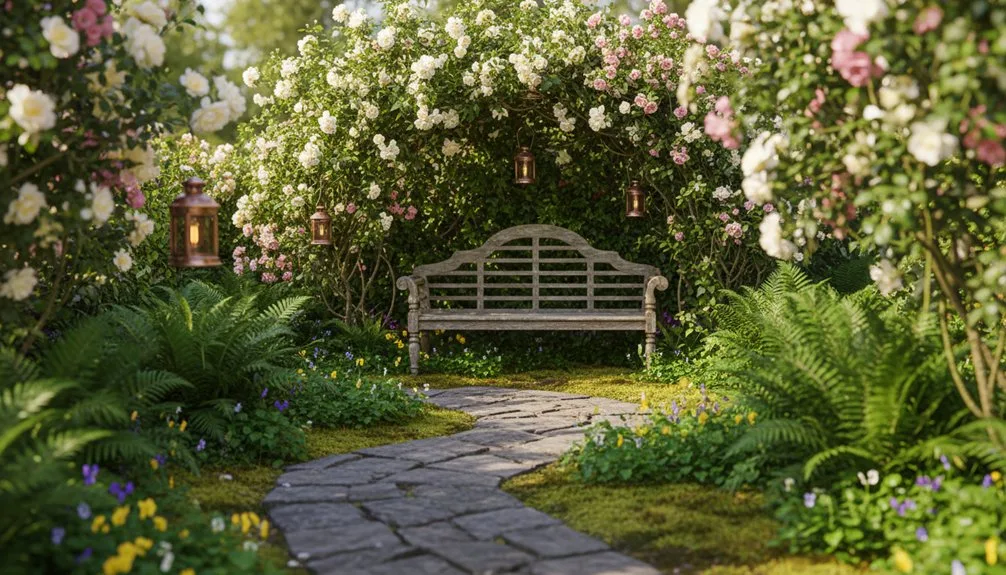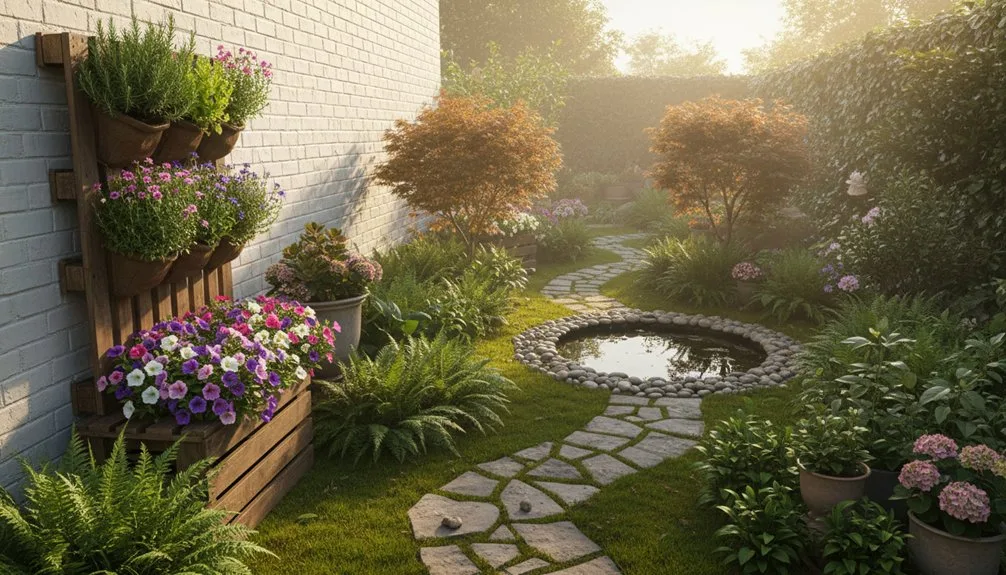
You’ll transform your compact backyard into a year-round showstopper by layering vertical structures, trained cordons, and succession plantings. Install wall-mounted planters with Supertunia and Swedish Ivy for continuous color. Train fruit trees as espaliers or cordons to fit tight footprints. Use columnar varieties like Sky Pencil Holly for height without sprawl. Plant climbing hydrangea and trumpet vine on pergolas for natural screening. Stagger container harvests weekly for constant productivity. Strategic paving and focal points create spatial illusions. Discover proven techniques that’ll have your neighbors asking for your secrets.
Key Takeaways
- Vertical wall gardens with hanging baskets and stacked containers maximize visual impact within minimal floor space.
- Columnar trees like Sky Pencil Holly and Blushing Delight™ Apple provide year-round structure without sacrificing growing room.
- S-shaped pathways with mixed pavers and pea gravel create visual depth and elongate compact garden areas.
- Succession planting cycles—rotating flowers every three months—maintain continuous color throughout seasons in small spaces.
- Pergolas with climbing vines and retractable screens establish private focal points while enhancing property aesthetics.
Year-Round Color in Small Spaces With Hanging Baskets

How can you transform a compact outdoor space into a season-long display of color? Hanging baskets provide the answer.
You’ll maximize vertical space while creating dramatic visual impact with minimal footprint.
Start by matching plants to your light conditions. In full sun, combine Supertunia petunias with trailing Swedish Ivy for contrast.
For shade areas, pair Streptocarpella’s delicate lilac blooms with Browallia’s violet flowers.
Plan in three-month increments, planting by late May for summer-long displays. Water full-sun plants when soil dries; keep shade plants evenly moist.
Fertilize petunias regularly; deadhead geraniums for continuous blooms.
As seasons shift, transition to fall mums, then overwinter Chinese lantern indoors under bright indirect light. This rotating strategy ensures your small space delivers consistent, captivating color year-round.
Turn Walls Into Living Gardens With Vertical Planters

Why settle for ground-level gardens when your walls offer untapped growing real estate?
You’ll transform bare surfaces into verdant displays using vertical planters that maximize your compact space.
Consider these installation options:
- Mount blue pots with cascading annuals like Supertunia ‘Pretty Much Picasso’ on south-facing walls
- Install self-watering Wally Eco planters in nine colors for effortless irrigation
- Arrange triple-tier metal structures for farmhouse aesthetics
- Position ferns and ivy on shaded walls where sunlight’s limited
- Layer mixed mounting methods—boxes, grids, and stackable containers—for dimensional interest
Select sun-loving succulents like houseleeks for dry wall crevices, or choose evergreen climbers such as star jasmine for year-round appeal.
Your wall gardens’ll fit within one square foot, turning fences into stunning gallery spaces while preserving ground-level planting areas.
Grow More in Less Space With Trained Fruit Trees
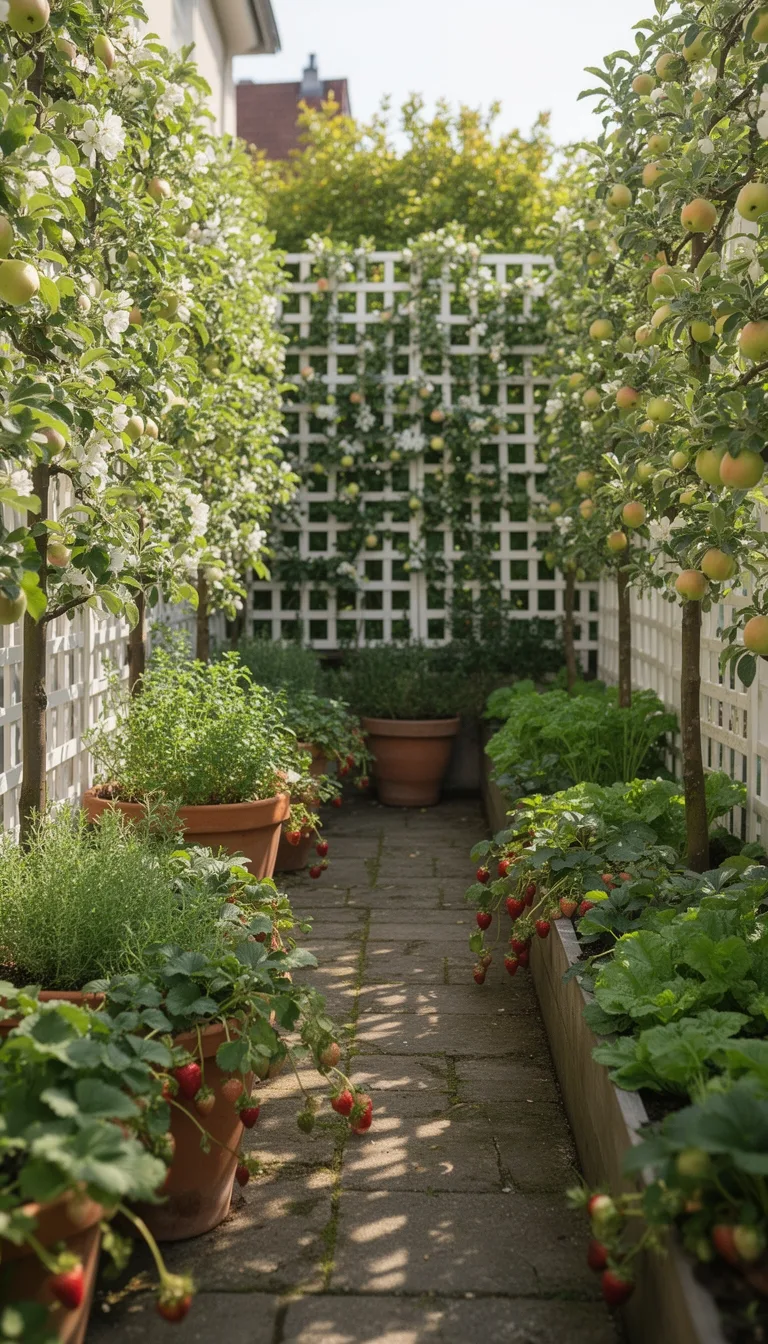
Just as vertical planters reclaim wall space, trained fruit trees transform compact gardens into productive orchards by directing growth along a single dimension.
You’ll choose from three main systems: cordons occupy minimal space at 75cm apart, espaliers fan horizontally across 3m widths, and fans radiate from short central trunks against walls.
Each method suits apples, pears, and stone fruits differently.
Semi-dwarf rootstocks are essential for small spaces, fitting within 3m × 2.5m footprints.
You’ll maintain these forms through annual pruning, removing unwanted shoots and tying limbs to supports.
The payoff’s significant—increased sunlight exposure accelerates ripening, and fruit stays within arm’s reach for easy harvesting.
High-nitrogen fertilizer initially promotes growth; switch to fruit-focused formulations in spring for maximum yields.
Use Climbers to Soften Hard Boundaries Fast
When you’ve got harsh walls and fencing boxing in your backyard, climbers offer the fastest solution for transforming those boundaries into lush, living features. Self-clinging varieties establish rapid coverage without requiring extensive infrastructure.
Consider these effective options:
- Climbing hydrangea – Attaches via aerial roots; provides year-round interest
- Trumpet vine – Fast-growing with stunning tubular flowers attracting pollinators
- Virginia creeper – Delivers lipstick-red autumn foliage and dense screening
- Ivy species – Creates immediate softening while supporting wildlife habitats
- Honeysuckle – Combines fragrant blooms with practical boundary coverage
You’ll notice these climbers soften rigid edges while utilizing minimal ground space.
Their vertical growth effectively transforms compact areas, making gardens feel larger while establishing privacy screens rapidly.
The aerial rootlets on self-clinging types mean you’re avoiding installation hassles—simply plant and watch them climb, covering eyesores and establishing lush boundaries within seasons rather than years.
Create Illusions of Space With Smart Paving Layouts
While climbers tackle your vertical boundaries, strategic paving layouts work horizontally to expand your garden’s perceived footprint.
Rectangular pavers laid lengthwise draw your eye outward, creating width illusions in compact spaces.
Alternatively, circular paving breaks monotonous straight lines and contrasts garden boundaries, redirecting focus away from cramped perimeters.
You’ll maximize usability by incorporating seat walls—they accommodate guests using minimal floor space while anchoring your patio.
Position piers as tables along lengths, leaving corners open for movement.
Consider mixing materials strategically: combine concrete with pea gravel for modern aesthetics while maintaining a balanced 50% paving-to-50% planting ratio.
Pavers over gravel resist cracking and offer superior durability.
Walkways guide traffic flow naturally, making your garden feel substantially larger while ensuring easy access throughout.
Choose Space-Saving Plants for Every Light Condition
The right plant selection transforms your compact garden into a lush, productive space—and light availability dictates which species’ll thrive in your layout.
You’ll maximize every square foot by matching plants to your site’s conditions.
For full shade areas, consider:
- Ferns and hellebores for year-round structure and winter blooms
- Coral bells offering architectural foliage in varied hues
- Ghost fern with silvery fronds that brighten dim corners
- Shade-tolerant herbs like mint and lemon balm in containers
- Leafy greens that bolt slower, extending your harvest season
Partial shade opens more possibilities: astilbe produces summer plumes, begonias deliver continuous color, and foxgloves create vertical interest.
For sunnier spots, coleus and primrose provide dynamic foliage and blooms.
This strategic approach eliminates wasted space while optimizing productivity.
Stack Containers on Multiple Levels to Multiply Planting Zones
Once you’ve matched plants to your site’s light conditions, you’ll amplify your growing space by building vertically—stacking containers creates multiple planting zones that transform a modest footprint into a thriving botanical display.
You can invert sturdy plastic pots inside larger containers as platforms, then stack graduated terra-cotta sizes for stable three-tier designs.
Drill holes in side walls to plant cascading varieties like nemesia around each level.
Begin planting from the top downward to prevent soil spillage, positioning low-growing annuals beneath any painted messages.
Plant front-to-back and side-to-side for even spacing across tiers.
Use plant caddies with casters for easy rotation and seasonal rearrangement.
This modular approach lets you swap annuals while evergreens maintain year-round structure, maximizing visual impact in limited space.
Design Curved Paths That Make Small Gardens Feel Bigger
How can you transform a cramped yard into an expansive garden sanctuary?
Curved pathways create visual mystery by obscuring your entire garden from any single vantage point, making modest spaces feel substantially larger. Your eye travels a longer journey through curves than straight lines, extending perceived depth naturally.
Consider these design strategies:
- Follow gentle arcs that mimic organic human movement patterns
- Place focal points at curve apexes to draw attention toward patios or flowering trees
- Use backward S-shaped configurations to redirect flow across different garden zones
- Adjust path width at gathering spaces near patios for intentional functionality
- Select materials like granite pavers or fieldstone that complement your landscape style
These curves invite exploration and slow movement, encouraging visitors to appreciate your plantings rather than rushing through. You’ll discover that gentle arcs transform claustrophobic yards into contemplative retreats.
Extend Your Garden Feeling Indoors With Container Plants
Why settle for enjoying your garden only during daylight hours outside? You’ll extend that garden feeling indoors with container plants that transform your living spaces while delivering measurable wellness benefits.
Container plants reduce airborne toxins by 75-90%, cleanse volatile organic compounds from furnishings, and lower stress markers including cortisol and blood pressure. They’ll boost your productivity by 12-15% and enhance cognitive performance, particularly in windowless rooms.
| Plant Type | Indoor Benefit |
|---|---|
| Cacti | Minimal care air purification |
| Purple plants | Reduce negative emotions |
| Green foliage | Enhance attention span |
| Low-light varieties | Improve workspace satisfaction |
| High-volume specimens | Maximize humidity control |
Position containers strategically throughout your home—3-10% green coverage yields optimal results. You’ll create visual continuity between indoor and outdoor spaces while simultaneously improving air quality and psychological well-being year-round.
Pick Trees That Reach Up, Not Out, for Tiny Spaces
Vertical architecture solves the gardener’s perpetual dilemma: you’ve got ambition but limited square footage.
Columnar trees deliver height without consuming your precious yard space.
Consider these stellar options for compact landscapes:
- Blushing Delight™ Columnar Apple (11 ft tall, 2-3 ft wide, zones 4-9) thrives in containers or ground
- Sky Pencil Holly (8-10 ft tall, 2 ft wide, zones 5-9) provides evergreen structure year-round
- Slender Silhouette Sweetgum (60 ft tall, 5-6 ft wide) offers fast vertical growth with stunning fall color
- Skyrocket Juniper (15-20 ft tall, 2-3 ft wide, zones 4-9) creates windbreaks in narrow side yards
- Flagpole Japanese Flowering Cherry delivers ornamental blooms in minimal footprint
These cultivars function as landscape exclamation points, delivering privacy, visual interest, and mature height—all without sprawling into your neighbors’ territory.
Create Bold Focal Points With Color, Texture, and Structure
A well-placed focal point transforms your backyard from a collection of plants into a purposeful outdoor room.
You’ll anchor your landscape by combining color, texture, and structure strategically.
Start with architectural plants like Japanese maple or agave—they naturally command attention.
Layer in bold colors through vibrant foliage or painted accessories to emphasize prominence.
Complementary hues create visual tension that makes focal points pop against surrounding elements.
Frame your focal point with structural elements: arbors, pergolas, or formal hedging establish hierarchy and divide space.
Position containers symmetrically beside central features like fountains to reinforce balance.
Negative space matters.
Leave room around your focal point so textural elements stand out without competition.
This intentional spacing creates dramatic visual impact and guides visitors through your garden naturally.
Grow Quick Harvests With Succession Planting in Containers
How can you harvest fresh greens, beans, or squash every week without replanting your entire garden? Succession planting synchronizes your harvests with household needs through strategic timing.
You’ll sow seeds at 7-21 day intervals, ensuring continuous production:
- Fast-growing greens (arugula, spinach) sown every 7 days
- Summer squash planted every 30 days
- Beans and peas staggered for reliable staple crops
- Container adaptations like weekly potato plantings yielding 28 per week
- Variety selection combining early, mid, and late-ripening cultivars
This method maximizes your square footage by reusing sowing spots multiple times seasonally.
You’ll replace harvested containers immediately with new plantings, extending your harvest window significantly. Succession planting also deters pests by disrupting their life cycles and reduces disease pressure through staggered plantings, creating healthier, more resilient plants while eliminating storage costs.
Use Pergolas to Create Privacy Without Claiming Ground Space
While succession planting keeps your containers producing throughout the season, you’ll also want to carve out a peaceful space where you can actually enjoy your harvest.
Pergolas offer the perfect solution—they shield you from neighbors’ views without consuming ground area, making them ideal for compact gardens as narrow as six feet wide.
Install lattice panels or train climbing plants like jasmine and wisteria overhead to create natural screening.
Their open design maintains airflow while blocking sightlines, transforming your backyard into a secluded retreat.
You can customize coverage with retractable drapes or modern slatted screens, adjusting privacy levels seasonally.
Beyond seclusion, pergolas reduce neighborhood noise, provide UV protection, and increase property value.
Strategic positioning maximizes effectiveness, especially when combined with vertical gardens for additional acoustic benefits.
Expand Planting Space With Budget-Friendly Gravel Gardens
Three elements transform compact yards into thriving garden spaces without breaking your budget: angular gravel, strategic layering, and thoughtful plant placement.
You’ll achieve stunning results by implementing these proven techniques:
- Spread 4-5 inches of 9-20mm angular gravel consistently, using stakes every 4-5 feet as depth gauges
- Layer fine gravel bases with larger rocks to create visual texture and depth
- Space plants 10-15 inches apart for community effect while isolating sculptural specimens like agave
- Design curved pathways with metal or stone edging to contain gravel and expand perceived space
- Incorporate stepping stones and gravel islands to break up narrow side yards
Gravel gardens require half the maintenance of traditional borders while thriving on rainfall alone. You’ll eliminate fertilizers and chemicals entirely. Position taller plants at back transitions, shorter varieties near paths. This approach maximizes planting density while maintaining breathing room, creating elegant, functional small gardens.
Grow Low-Maintenance, Drought-Tough Bloomers
Your gravel garden’s foundation of angular stones and strategic layering won’t reach its full potential without the right plants—ones that’ll thrive with minimal intervention while delivering consistent color.
Black-eyed Susans, gaillardia, and coneflowers produce vibrant blooms throughout the season while tolerating drought and poor soil.
Yarrow thrives in zones 3-8, requiring virtually no supplemental water once established.
Daylilies offer trumpet-shaped flowers in diverse hues with exceptional low-maintenance appeal.
For persistent pollinator activity, incorporate lavender, catmint, and bee’s bliss salvia—all drought-tolerant species with silvery foliage that complements your gravel aesthetic.
These selections demand deep but infrequent watering, well-draining soil, and minimal pruning beyond deadheading spent flowers, maximizing your garden’s visual impact while minimizing your workload.
Conclusion
You’ve now got the secret formula to transform your postage-stamp yard into an Instagram-worthy botanical masterpiece. Stack those hanging baskets, assault your walls with vertical planters, and train those fruit trees like they’re competing in the Chelsea Flower Show. Who needs sprawling estates when you can engineer miniature Eden through succession planting, drought-resistant perennials, and strategic hardscaping? Your neighbors won’t know what hit ’em.
The Only Tools You Need for a Thriving Garden 🌱
Whether you're a weekend gardener or growing daily — these hand-picked tools make every session faster, easier, and more satisfying.