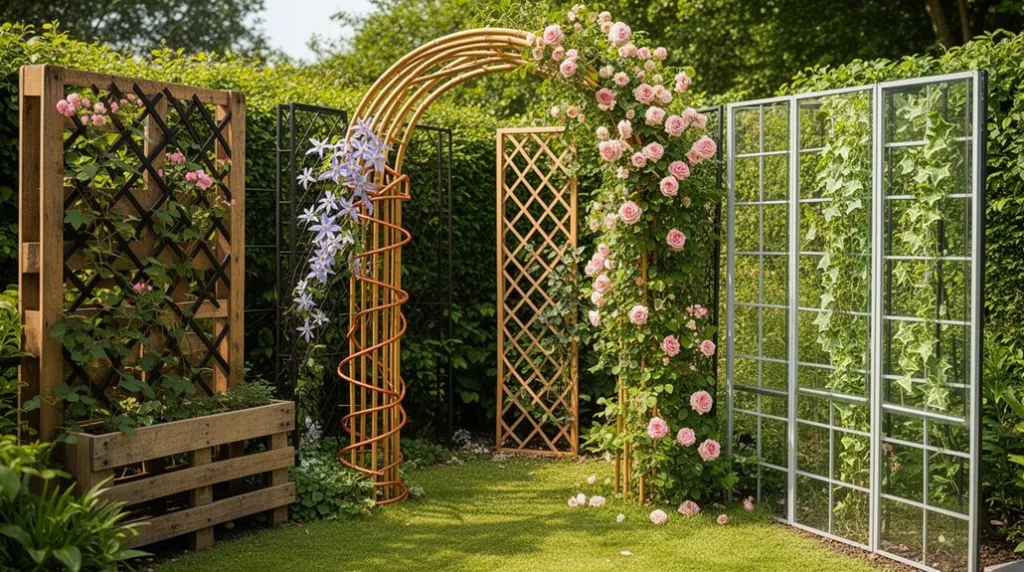
You’ve probably noticed how a well‑placed trellis can turn a modest garden corner into a thriving vertical showcase, guiding vines, tomatoes, and sweet peas to grow healthier and look more organized. By picking the right material—whether reclaimed pallet wood, galvanized pipe, or flexible bamboo—you can match the trellis to your plant’s weight, climate, and aesthetic. The trick lies in securing the structure, treating it for durability, and giving each climber enough room to mature without crowding. The next step reveals specific builds that balance cost, effort, and visual impact.
Key Takeaways
- Use repurposed pallets, ladders, or cinder blocks with galvanized wire mesh for budget‑friendly, modular trellises.
- Build sturdy arches or grids from galvanized steel pipe or PVC, spacing rods 6–8 in for robust climbers like cucumbers and kiwi.
- Incorporate UV‑resistant twine, stainless‑steel clips, or quick‑release clamps to secure vines and enable easy plant adjustments.
- Anchor trellis bases in concrete, sturdy posts, or driven T‑stakes to prevent wind sway and ensure stability.
- Add drip‑irrigation lines or trays beneath gutter‑style or arch trellises for consistent moisture and runoff control.
Why a Trellis Boosts Garden Health & Aesthetics

Because a trellis gives vines and climbing plants a structured support, you’ll see stronger stems, better airflow, and reduced disease pressure.
You’ll notice the plant’s vascular tissue thickening as it distributes nutrients more evenly, which translates into sturdier growth.
The open framework promotes sun penetration and air movement, limiting fungal spores and leaf spot.
It also encourages a natural, vertical habit that frees ground space for companion herbs or low‑lying flowers, boosting biodiversity.
A well‑placed trellis creates visual rhythm, guiding the eye upward and framing beds with graceful lines.
Choosing the Right Trellis Material & Size

Now that you’ve seen how a trellis improves plant vigor and garden layout, it’s time to match that benefit with the right material and dimensions.
Choose a material that suits your climate and plant weight: cedar resists rot for outdoor vines, while galvanized steel offers strength for heavy bloomers. For modest climbers like sweet peas, a 2‑inch‑wide wooden slat with 12‑inch spacing works; for robust cucumbers or kiwi, opt for 1‑inch‑diameter steel rods spaced 6‑8 inches apart.
Height should exceed the plant’s mature length by 12‑18 inches to encourage upward growth.
Ensure the base is anchored in concrete or a sturdy post to prevent wind‑induced sway, and double‑check that the lattice openings accommodate the plant’s leaf size for optimal support.
Upcycled Pallet Trellis – Free, Eco‑Friendly, Easy Build
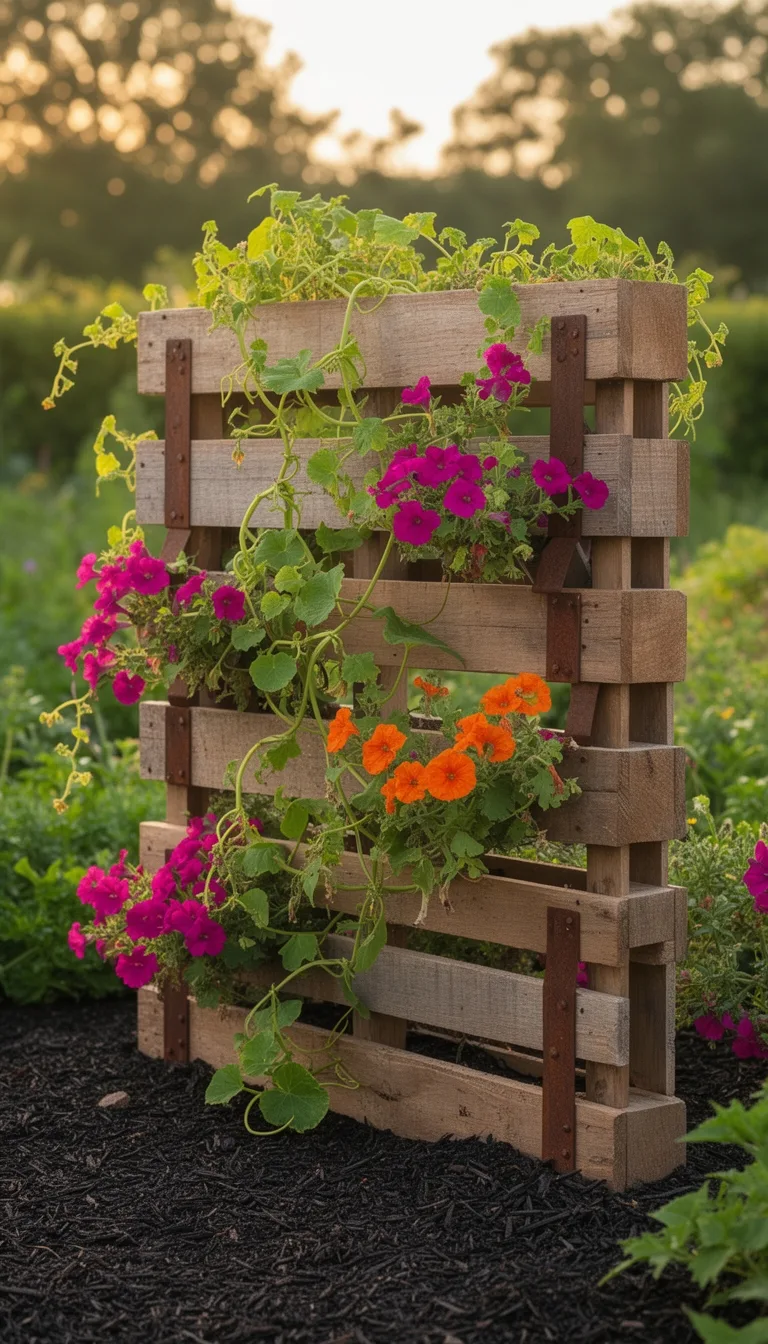
A repurposed pallet becomes a sturdy, eco‑friendly trellis in just a few steps, letting you turn garden waste into a thriving support system for vines and climbers.
First, select a pallet free of chemicals; sand any rough boards, then lay it flat on a ground surface. Attach 2×4 crossbars with exterior‑grade screws to create a grid, spacing them 6‑8 inches apart for adequate airflow. Drill pilot holes to prevent splitting, then secure the grid to the pallet’s frame. Apply a weather‑proof sealant to prolong durability.
Plant morning glories, sweet peas, or clematis at the base, guiding shoots through the openings. As the vines grow, they’ll twine naturally, filling the pallet with lush foliage and vibrant blooms.
Metal Pipe Grid Trellis – Industrial Look, Simple Assembly
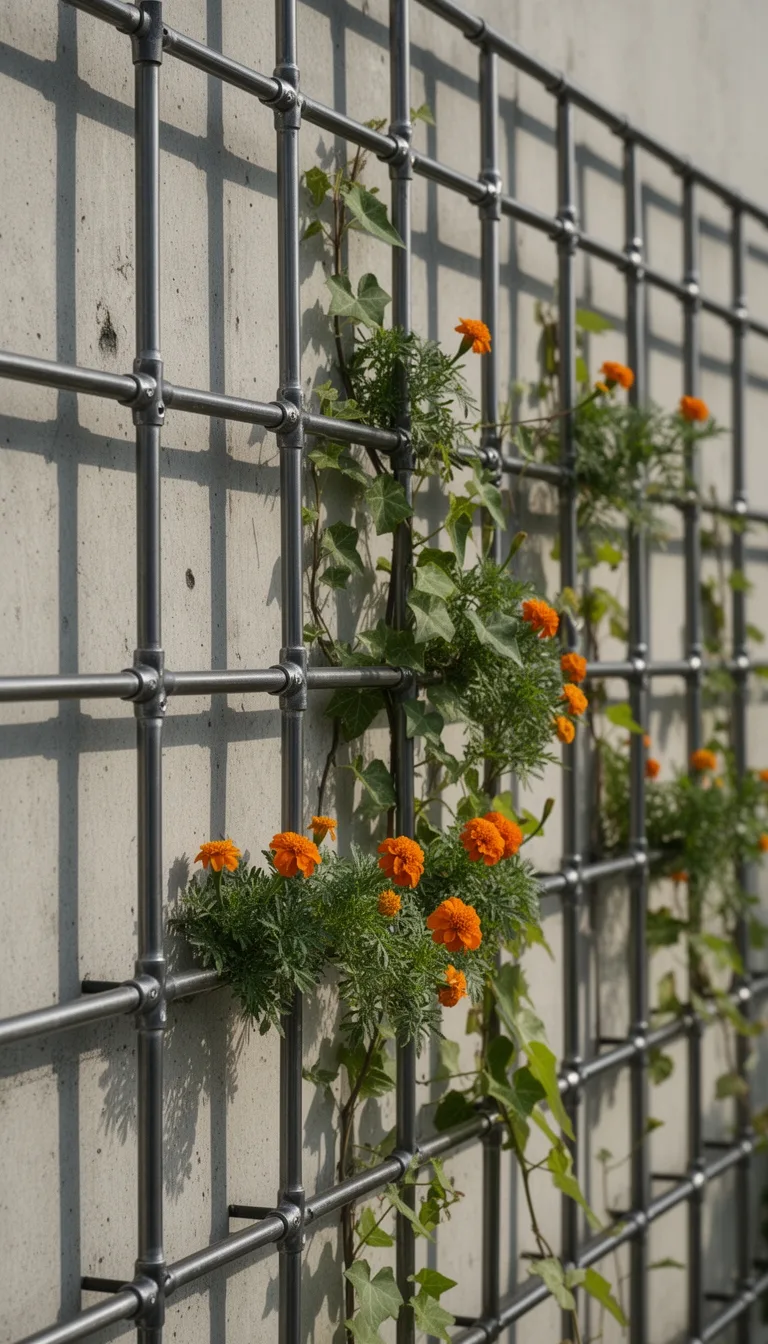
Craft a sleek, industrial‑style trellis by assembling a simple grid of galvanized steel pipe and fittings, then you’ll have a durable support for climbing roses, beans, or kiwi vines that withstands weather and adds a modern edge to any garden.
Measure a 4‑ft square, cut two 4‑ft horizontal pipes and four 4‑ft vertical pipes, then drill 1‑inch holes at each corner.
Insert 90‑degree elbows to lock corners, and use pipe clamps to secure the grid to a fence or post.
The galvanized coating resists rust, keeping the trellis sturdy through rain and sun.
Plant climbers at the base, train tendrils onto the mesh, and prune regularly to encourage airflow and light penetration.
This low‑maintenance structure supports vigorous growth while showcasing an industrial aesthetic.
Bamboo Stick Lattice – Light, Flexible, Fast‑Growing Support

If you prefer a lighter, more organic look, bamboo sticks give you a flexible lattice that’s easy to assemble and blends seamlessly with fast‑growing vines.
Cut 6‑ft poles into 12‑inch sections, then split each length lengthwise for extra flexibility.
Arrange the split sticks in a criss‑cross pattern, securing intersections with garden‑grade twine or stainless‑steel clips.
Space the lattice about 6‑8 inches apart to let vines like morning glory, clematis, or sweet peas find grip without crowding.
The natural texture encourages beneficial microbes, while the porous walls allow water to wick to the root zone, reducing irrigation needs.
Replace any broken stick annually to keep the structure stable and aesthetically fresh.
- Use ½‑inch diameter bamboo for sturdier support
- Secure with UV‑resistant twine to avoid rust
- Space intersections 6‑8 inches for optimal vine growth
DIY Macramé Hanging Trellis – Boho Charm for Small Spaces
When you’re short on floor space but still want a lush vertical garden, a macramé hanging trellis offers a lightweight, boho‑inspired solution that lets vines cascade from ceiling or balcony rail.
Choose a sturdy cotton or jute rope, cut four 12‑foot strands, and form a basic square knot at the top to create a hanging loop.
Tie a series of alternating square and half‑hitch knots down the length, spacing them 2‑3 inches apart; this creates a mesh that supports stems while allowing airflow.
Attach the finished trellis to a hook or rail with a carabiner, then train ivy, sweet peas, or trailing thyme through the knots.
Trim regularly to prevent tangling, and water plants from the bottom to keep the rope dry and strong.
Garden Hose Pipe Frame – Waterproof, Adjustable, Reuse‑Ready
Even a modest garden can benefit from a sturdy, waterproof frame that holds a hose pipe in place, letting you direct water exactly where your plants need it.
You’ll start with PVC pipe sections, cut them to the desired height, and connect them with rust‑proof couplings.
Slip a flexible hose through the central channel, then secure it with zip ties that can be loosened for adjustment.
Apply a silicone sealant at every joint to keep moisture out and prevent rust.
The frame’s modular design lets you re‑position it as vines grow, and you can reuse the same components each season, saving money and reducing waste.
- PVC vertical posts with drilled holes for hose passage
- Adjustable crossbars that lock into place with clamps
- Waterproof silicone‑coated joints for long‑term durability
Wooden Ladder Trellis – Vertical Garden for Vines & Herbs
Turn an old wooden ladder into a sturdy, space‑saving trellis that lets vines and herbs climb vertically while keeping your garden tidy.
First, clean the ladder, sand rough edges, and treat it with a weather‑proof sealant to protect against rot.
Position the ladder against a wall or fence, anchoring the base with stakes or concrete blocks for stability.
Space the rungs 12‑18 inches apart; this spacing accommodates the root systems of thyme, rosemary, and climbing beans, while allowing air flow to prevent mildew.
Tie vines such as clematis, morning glory, or sweet peas to the rungs with soft garden twine, adjusting as they grow.
Trim foliage regularly to maintain a tidy silhouette and encourage vigorous, upward growth.
This vertical garden maximizes limited space, adds structural interest, and creates a micro‑habitat for pollinators.
Cinder Block & Wire Trellis – Sturdy, Modular, Budget‑Friendly
Stack cinder blocks and welded wire to create a sturdy, modular trellis that’s perfect for tomatoes, cucumbers, and flowering vines.
You’ll first arrange the blocks in a rectangular frame, leaving a 2‑inch gap between each for drainage.
Then cut galvanized wire mesh to the block height, staple or tie it to the block corners, and tension it with a come‑alike turnbuckle for extra rigidity.
The wire’s grid supports vines while allowing airflow, reducing fungal risk.
When a block cracks, you simply replace it without dismantling the whole structure, keeping costs low and maintenance easy.
This system scales horizontally or vertically, fitting balconies, raised beds, or garden edges.
- 2‑block high frame with 4‑inch spacing
- Galvanized wire mesh (½‑inch grid) stretched tight
- Turnbuckle tensioner for adjustable support
PVC Arch Trellis – Curved Support for Roses & Clematis
When you bend a length of PVC pipe into a graceful arch and anchor it with sturdy stakes, you create a lightweight, weather‑resistant framework that lets roses and clematis climb in elegant curves.
Cut 3‑inch schedule‑40 pipe to a 5‑foot span, heat‑soften with a hair dryer, and shape the curve on a workbench.
Drill ½‑inch holes every 12 inches for tie‑backs; use UV‑resistant twine to secure can. Install two galvanized T‑stakes at each end, driving them 18 inches deep for stability.
Add a lower cross‑bar to guide new shoots and prevent sagging.
Position the arch where morning sun meets afternoon shade; roses will produce abundant blooms, while clematis will twine naturally, using the arch’s curvature as a support lattice.
Regularly prune to maintain airflow and reduce disease.
Repurposed Gutter Trellis – Narrow, Space‑Saving Design
If the arch works well for larger vines, a slim, gutter‑style trellis can make the most of tight garden aisles or patio railings. You’ll need a clean, straight rain‑gutter, a few brackets, and a drill.
Cut the gutter to the desired length, sand any sharp edges, then mount it horizontally or at a slight angle using stainless‑steel brackets. Slip a few garden twine or soft wire through the gutter’s perforations, creating a gentle lattice for sweet peas, morning glories, or dwarf clematis.
Water‑proof sealant protects the metal, and a drip tray beneath catches runoff, keeping the soil moist but not soggy.
- Cut and sand a 3‑ft aluminum gutter
- Attach 2‑inch brackets 12 in apart, level or slight tilt
- Thread twine through perforations, spacing 2‑in for vines
Tree‑Stump Base Trellis – Natural Anchor for Climbing Flowers
Using an old tree stump as a sturdy anchor, you can create a natural‑looking trellis that lets climbing flowers like roses, clematis, or honeysuckle surge upward while the stump’s root mass provides stability.
First, select a stump at least 12‑inch diameter and 18‑inch height; remove loose bark and treat the surface with a wood preservative to deter rot.
Drill a series of ½‑inch holes around the top rim, spacing them 6‑inch apart, then insert galvanized steel rods or bamboo canes, securing each with epoxy or stainless‑steel washers.
Tie the vines to the rods using soft garden twine, allowing two weeks for the plants to find their grip.
Add a drip‑irrigation line at the base, ensuring consistent moisture for vigorous growth.
Trim excess growth annually to maintain shape and encourage blooming.
Rustic Branch Frame Trellis – Minimal‑Tool, Country Aesthetic
Even a modest collection of fallen branches can become a sturdy, country‑style trellis with just a few tools and a bit of patience.
First, select straight, dry limbs about 1‑2 inches thick and cut them to equal length (around 5 ft). Strip bark where the branches will intersect, then drill pilot holes and secure them with galvanized screws, forming a rectangular frame. Reinforce corners with metal brackets if needed.
Finally, drive a few longer stakes into the ground and attach the frame with twine or rope, creating a tensioned, rustic support for vines, clematis, or roses. The natural texture encourages beneficial insects and adds visual interest to any garden bed.
- Rectangular frame of 4‑6 ft branches, secured with screws
- Corner brackets or extra stakes for stability
- Twine‑tightened attachment to ground stakes for tension
Fabric‑Wrapped Wire Trellis – Soft Edge for Delicate Blooms
Often you’ll find that a simple metal wire frame can be softened for fragile flowers by wrapping it in breathable fabric; start by cutting a galvanized or stainless‑steel wire mesh to the desired height and width, then staple a lightweight, UV‑resistant cotton or linen cloth onto the mesh, pulling the fabric taut and securing it with rust‑proof staples or zip‑ties at regular intervals. Choose a light pastel hue to complement petal tones and avoid heat buildup. Trim excess fabric, then treat the mesh with a rust inhibitor for longevity. Position the trellis against a sunny wall, allowing vines to climb through the softened gaps without snagging delicate blooms.
| Step | Tip |
|---|---|
| 1 | Cut mesh to size |
| 2 | Use UV‑resistant cotton |
| 3 | Staple every 6 in |
| 4 | Apply rust inhibitor |
| 5 | Place near sun‑lit wall |
Portable Folding Trellis – Move‑Around Support for Seasonal Plantings
After softening a static mesh with breathable fabric, you can take the flexibility a step further with a portable folding trellis that you can reposition as seasons change.
Choose lightweight aluminum or coated steel hinges, and cut sections to 3‑foot segments that fold flat for storage. Attach quick‑release clamps so you can slide the trellis between a vegetable bed, a container garden, or a patio border.
When spring arrives, unfold the frame, spread the mesh, and let vines like cucumbers, beans, or morning glories climb. In autumn, collapse it, relocate to a sunny spot for geraniums, or store it away to prevent rust.
This modular approach lets you match support to growth cycles without permanent installations.
- Hinged aluminum sections, 3‑foot each, fold flat
- Quick‑release clamps for easy repositioning
- Mesh panels with breathable fabric for root airflow
Conclusion
Now’ve got a toolbox of trellis options that fit any garden style and budget. By picking the right material, sizing it for mature growth, and anchoring it securely, you’ll give climbers the support they need to thrive. Add a drip line, treat wood or metal for weather resistance, and watch vines and flowers climb faster, bloom brighter, and keep your garden looking lush and organized all season long.
The Only Tools You Need for a Thriving Garden 🌱
Whether you're a weekend gardener or growing daily — these hand-picked tools make every session faster, easier, and more satisfying.