You’ll transform your backyard into a paradise by anchoring your design around a central axis with a focal water feature—like a fountain on a pebble base—as your organizing element. Position mirrored beds, pathways, and seating inward-facing toward this centerpiece. Layer bold tropical foliage like elephant-ears and caladiums at staggered heights to create depth and lushness. Define walkways at least 4 feet wide for smooth flow. Install vertical accents such as arbors and trellises for climbing vines. These foundational steps’ll establish your oasis framework, though there’s considerably more strategy to perfect every layer.
Key Takeaways
- Create a central axis with a focal water feature (fountain or statue) to organize the entire garden layout and guide visitor flow.
- Layer plants by height—tall canopy trees, medium shrubs, and low perennials—to build visual depth and immersive lushness throughout the space.
- Mirror beds, urns, and lanterns symmetrically on both sides of pathways to establish balanced, harmonious garden composition and rhythm.
- Use container gardening for tropical fruits like mangoes and avocados; move indoors seasonally to extend growing seasons and maximize productivity.
- Install arbors and trellises for climbing roses and wisteria while positioning seating inward-facing toward focal points for optimal view enjoyment.
Start Your Tropical Garden With Symmetry
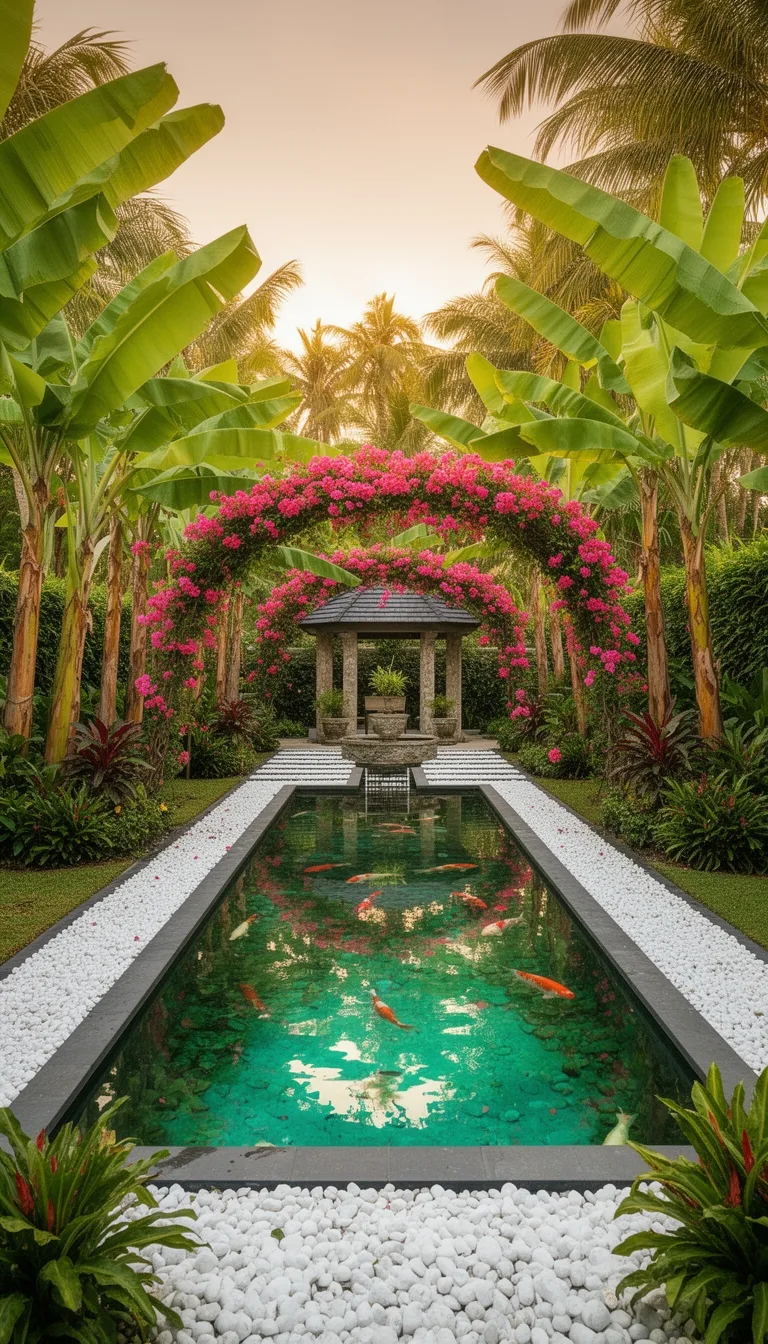
How can you transform a tropical garden into an orderly, visually striking space?
Start by establishing a central axis—your garden’s backbone.
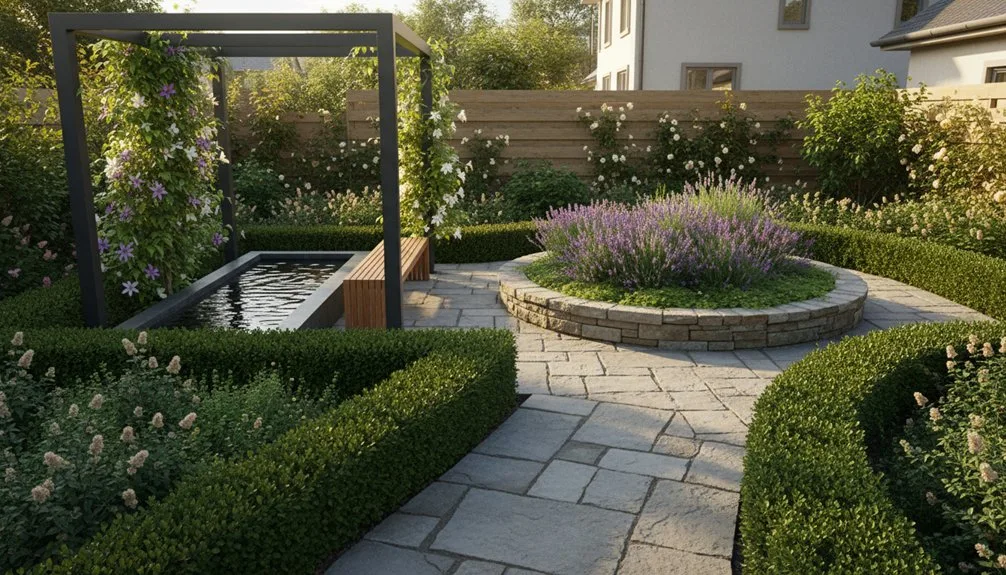
Position a focal point like a fountain or statue at the center, then mirror planting beds, urns, and lanterns symmetrically on both sides. Align pathways and hedgerows along this axis to guide visitors naturally through your garden.
Reinforce symmetry through strategic repetition.
Plant trees in odd numbers—three, five, or seven—at regular intervals.
Use matching pairs of palms or pollarded trees in quadrants.
Mirror perennial clumps like lavender on each side, maintaining consistent scale and form.
This methodical approach creates visual harmony.
Symmetrical designs convey stability and elegance while taming tropical abundance.
Your entrance courtyard or terrace gains immediate sophistication and order.
Select Bold Tropical Foliage for Density

Why does a tropical garden often feel incomplete despite having plenty of plants? You’re likely missing bold foliage that creates visual density and drama.
Bold-leafed plants anchor your design with impact:
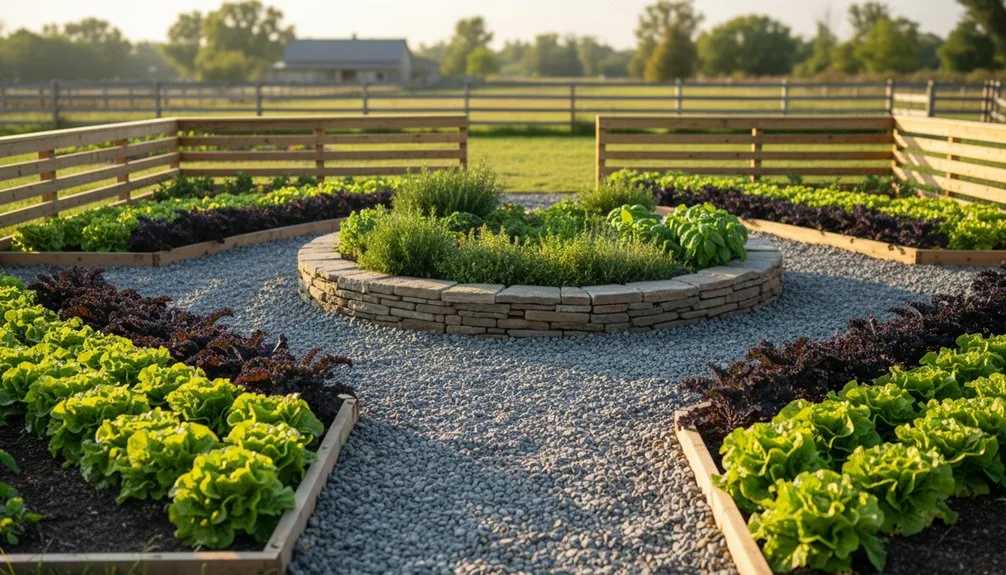
- Elephant ears and colocasia deliver oversized leaves that command attention and fill visual gaps instantly
- Banana plants and bird of paradise provide glossy, paddle-shaped foliage that grounds your landscape as focal points
- Caladiums offer broad understory leaves that layer density beneath taller specimens
Plant these varieties in strategic groupings rather than scattered singles. This approach builds cohesion while maximizing the lush, immersive feel you’re after.
Position bold foliage at varying heights to create visual rhythm.
Layer them with mid-level fillers like hibiscus and cordylines for seamless transitions. Your garden transforms from sparse to densely tropical through deliberate foliage selection and methodical placement.
Design a Central Water Feature as Your Focal Point

Once you’ve layered your garden with bold tropical foliage, anchor the entire composition with a central water feature that commands visual attention and ties your design together.
Position an expansive fountain on a pebble base as your garden’s geometric centerpiece, whether you choose bowl-shaped designs with multiple waterspouts or modern square fountains featuring copper channels.
Center it on your patio or deck where it naturally draws the eye.
Install underwater LED lights to enhance the feature during evening hours, creating dramatic focal-point appeal.
Surround your fountain with complementary materials—decorative stones, ornamental rocks, and creeping juniper—to integrate it seamlessly into your landscape.
This strategic placement transforms your water feature into the garden’s essential organizing element, elevating your entire backyard design.
Layer Plants to Mimic a Natural Canopy
What transforms a flat garden into a dynamic landscape? Layering plants to create a natural canopy structure.
You’ll build depth and visual interest by arranging vegetation at graduated heights, mimicking forest ecosystems.
Start with tall trees like oaks and maples forming your canopy top.
Transition down through medium shrubs such as serviceberry and viburnum, then smaller perennials and ground covers.
This vertical arrangement creates natural flow and habitat.
Consider these elements:
- Select canopy trees based on your hardiness zone and sun exposure requirements
- Stagger understory shrubs at 2-6 feet, weaving them into the canopy for seamless transitions
- Mass perennials and ground covers at foreground heights, offsetting depths to enhance spatial illusion
Fill Tropical Containers for High-Impact Planting
If you’ve mastered vertical layering in garden beds, you’ll find tropical containers offer a concentrated way to showcase bold, dramatic planting without requiring extensive ground space.
Start by selecting large containers—they accommodate fast-growing tropical plants and reduce watering frequency.
Use the thriller, filler, spiller framework: position tall specimens like mini palms or elephant ears as your thriller centerpiece, surround them with mid-sized mounding plants like coleus or begonias as fillers, then add cascading calibrachoa as spillers.
Choose foliage-forward plants with large, glossy leaves and varying textures.
Ensure all plants share similar sun, water, and soil requirements.
Apply regular fertilizer to maintain vibrancy throughout the season.
Position Seating and Pathways for Flow
Just as tropical containers create visual impact through intentional layering, your outdoor layout thrives when you deliberately position seating and circulation routes to guide movement and encourage gathering.
Start by establishing primary walkways with minimum 4-foot widths, maintaining 30–36 inches of clearance for comfortable passage.
Position dining areas 36–48 inches behind chairs, allowing guests to sit and stand unobstructed.
Arrange seating inward-facing toward focal points like fire pits or views rather than pushing furniture against walls.
- Create distinct zones: grilling, dining, and lounging areas functioning as separate outdoor rooms
- Design curved pathways that naturally guide visitors through spaces while straight routes offer direct movement
- Use offset groupings and landscaping to visually separate gathering spots while maintaining conversation-friendly distances
Add Height and Drama With Vertical Accents
Your strategically positioned pathways and gathering spaces create the foundation; now build upward to maximize your garden’s visual impact and growing potential.
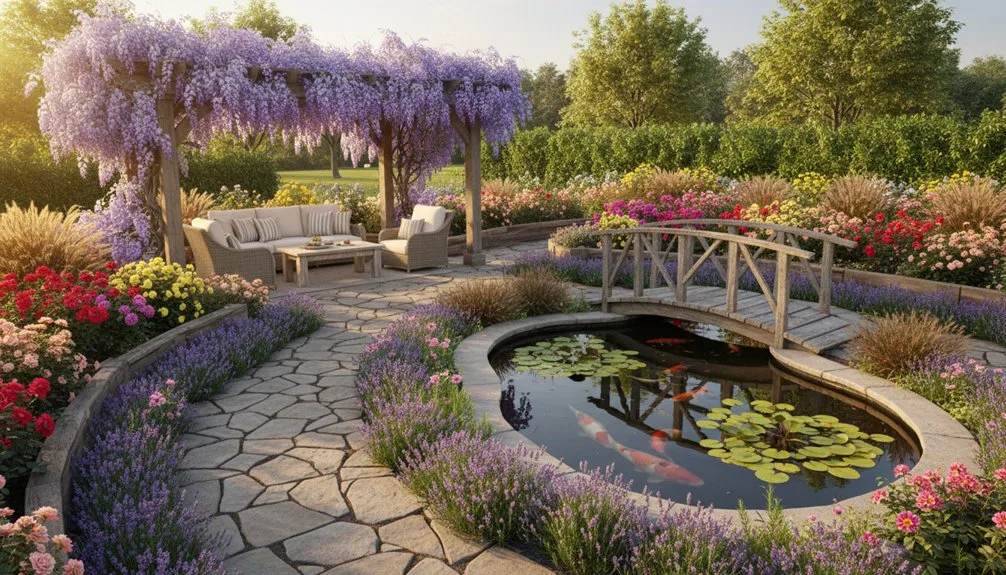
Install arbors, trellises, and pergolas to train climbing roses, wisteria, and clematis upward.
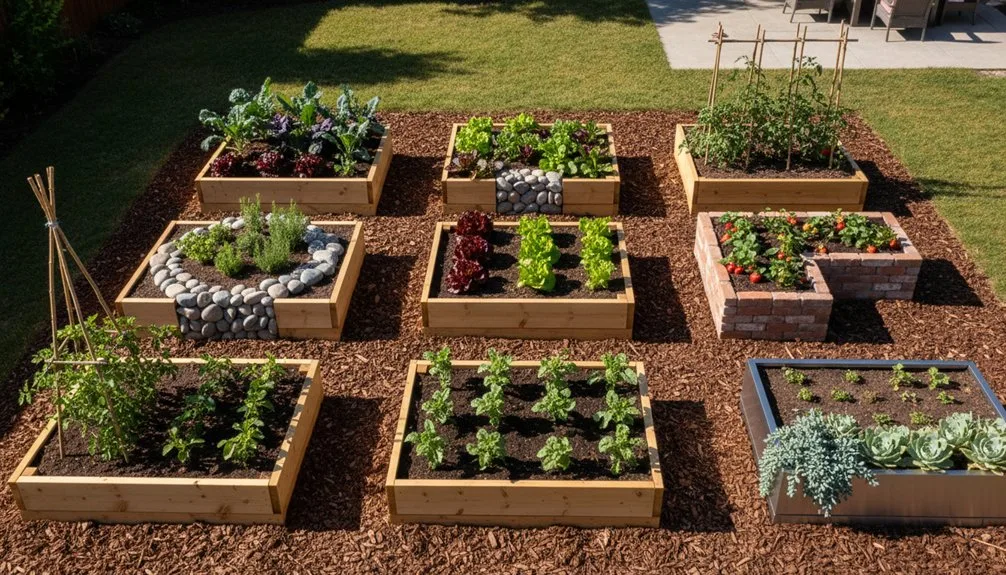
Obelisk trellises in raised beds support pole beans, peas, and tomatoes while drawing eyes skyward, making compact spaces feel expansive.
Train vining plants on fence walls using ivy’s aerial roots or espalier techniques for structured growth.
Incorporate hanging baskets and wall-mounted planters for trailing petunias and begonias.
Panel trellises positioned down bed centers double your growing space on both sides.
These vertical structures transform flat landscapes into dynamic, layered gardens that captivate and produce abundantly.
Light Your Oasis for Evening Ambiance
As twilight settles over your garden, thoughtfully positioned lighting transforms your outdoor space into an enchanting retreat that extends your enjoyment well beyond daylight hours.
You’ll create layered ambiance by combining multiple lighting techniques strategically throughout your garden.
Start with pathway lights along walkways for safe navigation, then add string lights draped across pergolas or trees for warmth.
Position uplighting against architectural features or trees to establish depth and drama.
Consider these key elements:
- Pendant lights and lanterns hung above seating areas cast intimate, diffused illumination perfect for gatherings
- Solar pathway lights automatically activate at dusk, requiring no wiring while illuminating garden routes
- Fire features like chimineas provide focal points that layer beautifully with string and uplighting
This methodical approach creates sophisticated evening spaces where you’ll linger comfortably.
Grow Tropical Plants in Your Climate Zone
How can you cultivate tropical plants successfully outside their native regions?
You’ll need to match plants to your hardiness zone and employ strategic protection methods.
In Zone 9B, you can grow bananas, mangoes, and avocados with frost protection during cold spells.
Cover plants with frost cloth or blankets when temperatures drop.
String holiday lights around larger trees for added warmth, and mulch heavily around the base.
For zones with harsher winters, container gardening offers flexibility.
Grow mangoes and avocados in large pots, then move them indoors or to greenhouses during winter months.
Insulate container roots with bubble wrap to protect them from cold damage.
Position all tropical plants in full sun, ideally south-facing spots receiving six to eight hours daily.
This maximizes heat absorption and promotes vigorous growth in your climate zone.
Conclusion
You’ve now got all the tools to transform your backyard into a tropical paradise. Start by mapping out your space with symmetry, then layer in foliage and water features. You’ll want to position seating strategically, add vertical accents, and install lighting—think of it like you’re curating an Instagram feed from the 1950s. Follow these methodical steps, and you’ll create an oasis that’ll have you forgetting you’re in your own climate zone.
The Only Tools You Need for a Thriving Garden 🌱
Whether you're a weekend gardener or growing daily — these hand-picked tools make every session faster, easier, and more satisfying.