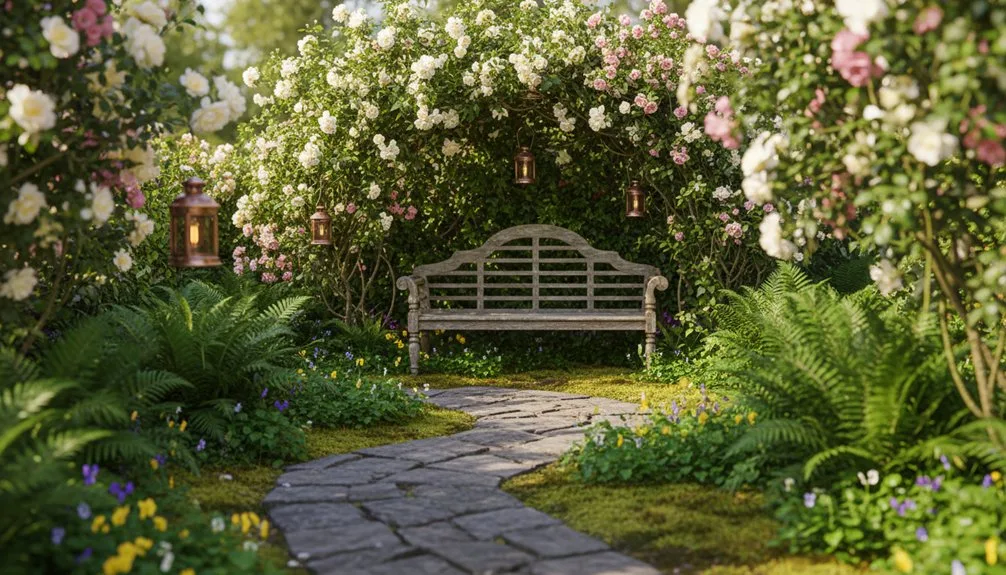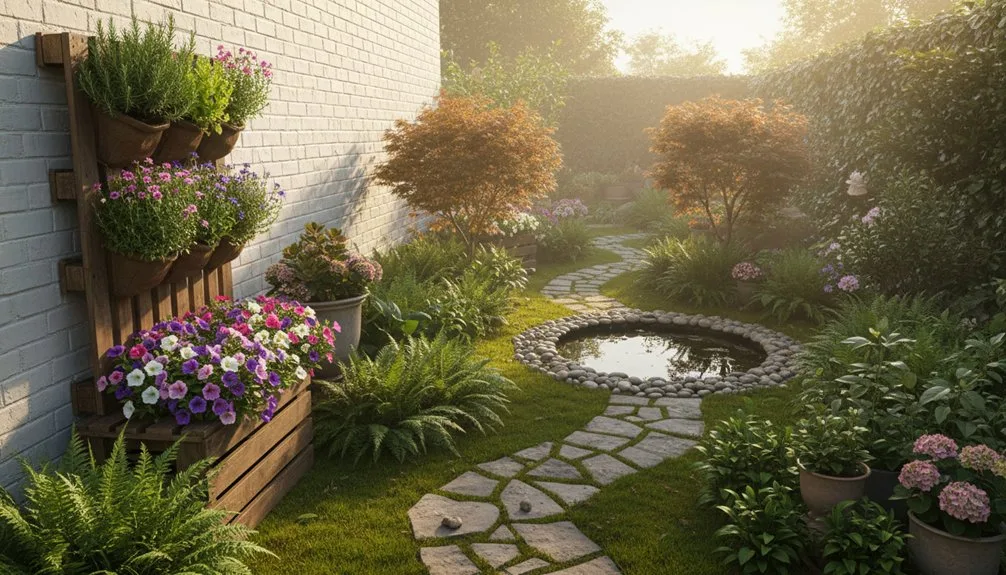
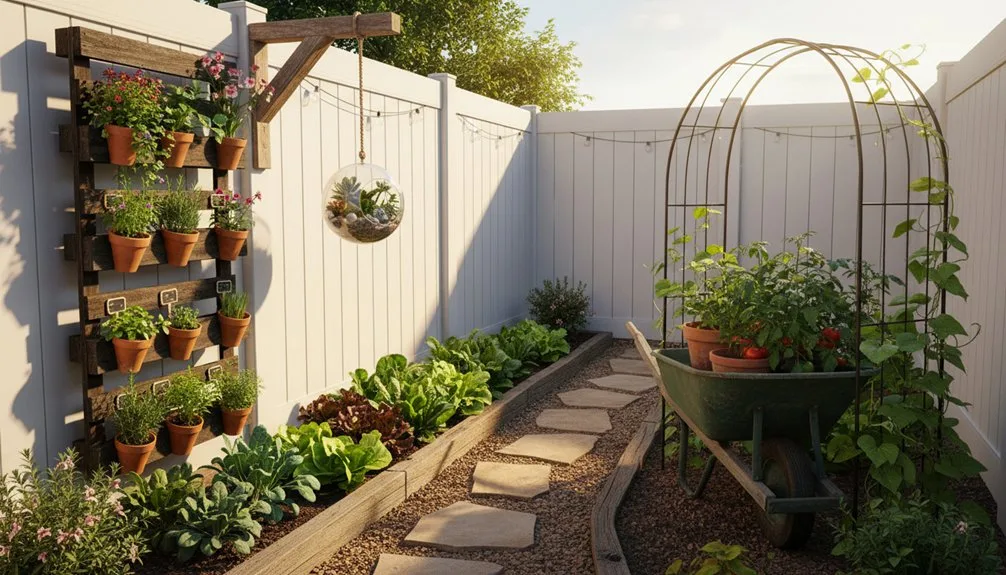
You’ll transform your cramped backyard by layering vertical structures, angled patios, and multifunctional elements that maximize every square foot. Install wall planters, trellises, and tiered stands to expand growing space upward rather than outward. Angle your hardscape diagonally to redirect sightlines and create perceived depth. Choose dwarf varieties and fast-cropping vegetables in raised beds for superior drainage and earlier harvests. Use dense border plantings to blur boundaries inward. Strategic zoning with outdoor rugs, storage benches, and focal-point pedestals delineates functional areas while maintaining visual flow. These foundational techniques unlock considerably more design possibilities ahead.
Key Takeaways
- Maximize vertical space with trellises, wall planters, and tiered stands to grow more plants in confined areas without expanding footprint.
- Install raised beds for earlier planting, extended harvests, custom soil mixes, and reduced bending—a 4′×8′ bed yields comparable to larger in-ground areas.
- Use angled patios and spatial zoning with pergolas and arches to create perceived depth and make limited square footage feel larger.
- Select dwarf, columnar, and shade-tolerant varieties like Sky Pencil Holly and compact perennials to maintain year-round interest with minimal spread.
- Implement multi-functional features such as storage benches and dense edge plantings that blur boundaries while serving practical and aesthetic purposes simultaneously.
Plan Your Small Garden Around Three Core Principles
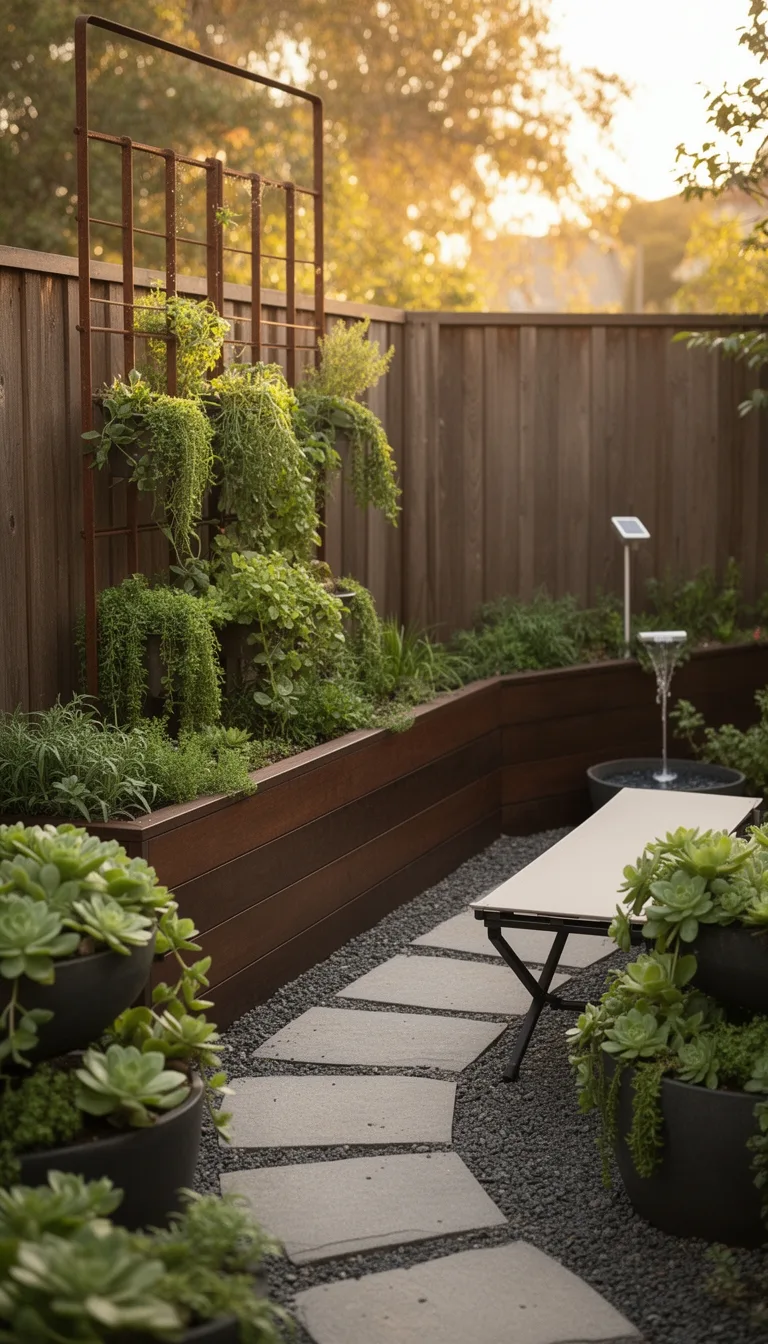
Whether you’re working with a modest urban lot or a cramped backyard, designing an effective small garden hinges on three foundational principles: flexibility, practicality, and harmony.
Flexibility lets you maximize limited space through multitasking designs.
Incorporate architectural structures like trellises to add verticality, transforming your garden into different functional zones throughout the day and seasons.
Practicality ensures you avoid overcrowding.
Use tape to plan furniture layouts before purchasing, select appropriately scaled pieces, and define beds with edging to prevent grass encroachment.
Harmony ties everything together visually.
Choose neutral palettes and natural materials, then unify your design through repeating curves or lines.
Edit ruthlessly—every element needs purpose and breathing room.
Angle Your Patio to Expand Visual Space
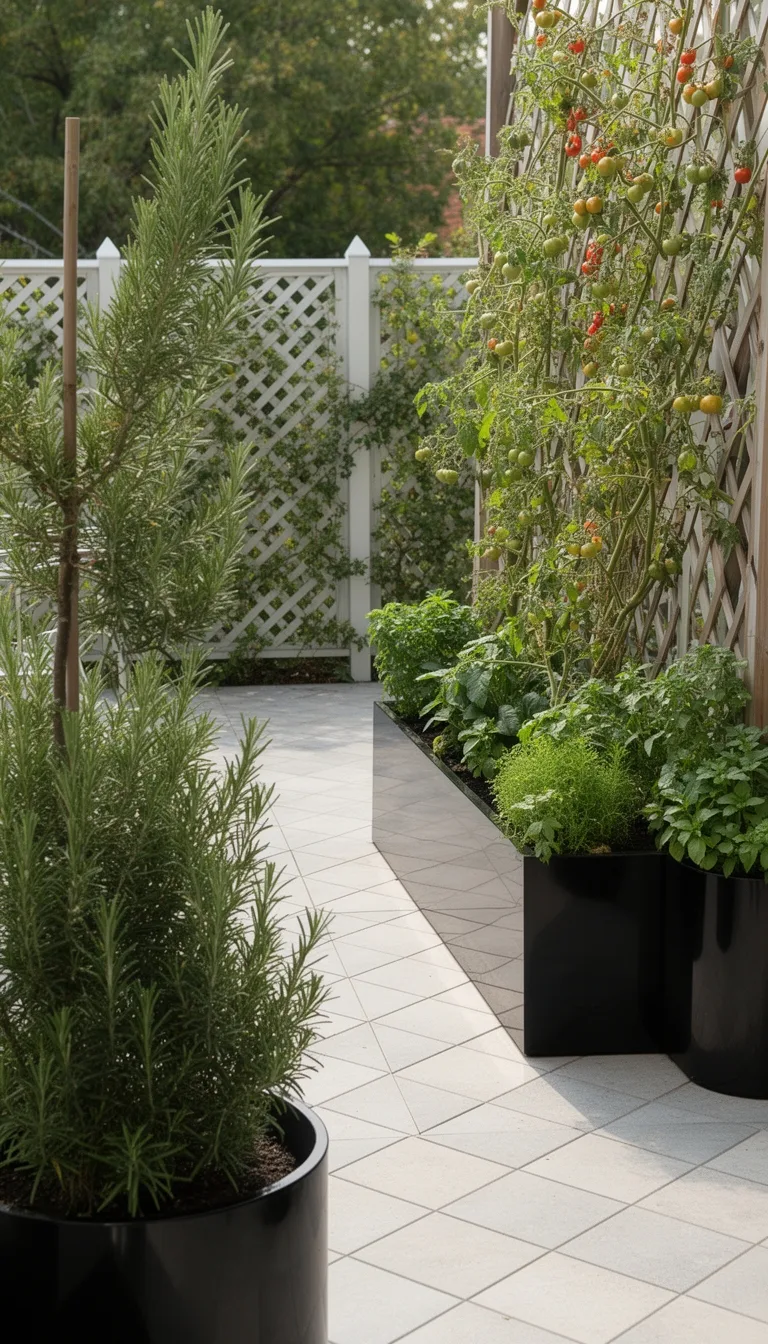
How can you stretch a cramped outdoor space without expanding your property line?
Angling your patio redirects sightlines away from property boundaries, creating perceived depth that makes your yard feel larger.
Diagonal positioning breaks up rectangular divisions that typically confine small spaces, while elevation changes add architectural dimension to flat areas.
Sloped surfaces naturally handle drainage, eliminating standing water that damages finishes and structures.
A gentle 5-8% grade maintains accessibility while moving water downhill efficiently.
Angled layouts also increase furniture flexibility, accommodating diverse seating arrangements without awkward empty corners.
Construction costs drop when you work with natural topography instead of against it.
Strategic excavation on gentle slopes minimizes earthwork compared to complete yard leveling, reducing both labor and material expenses significantly.
Maximize Vertical Growth With Wall Planters
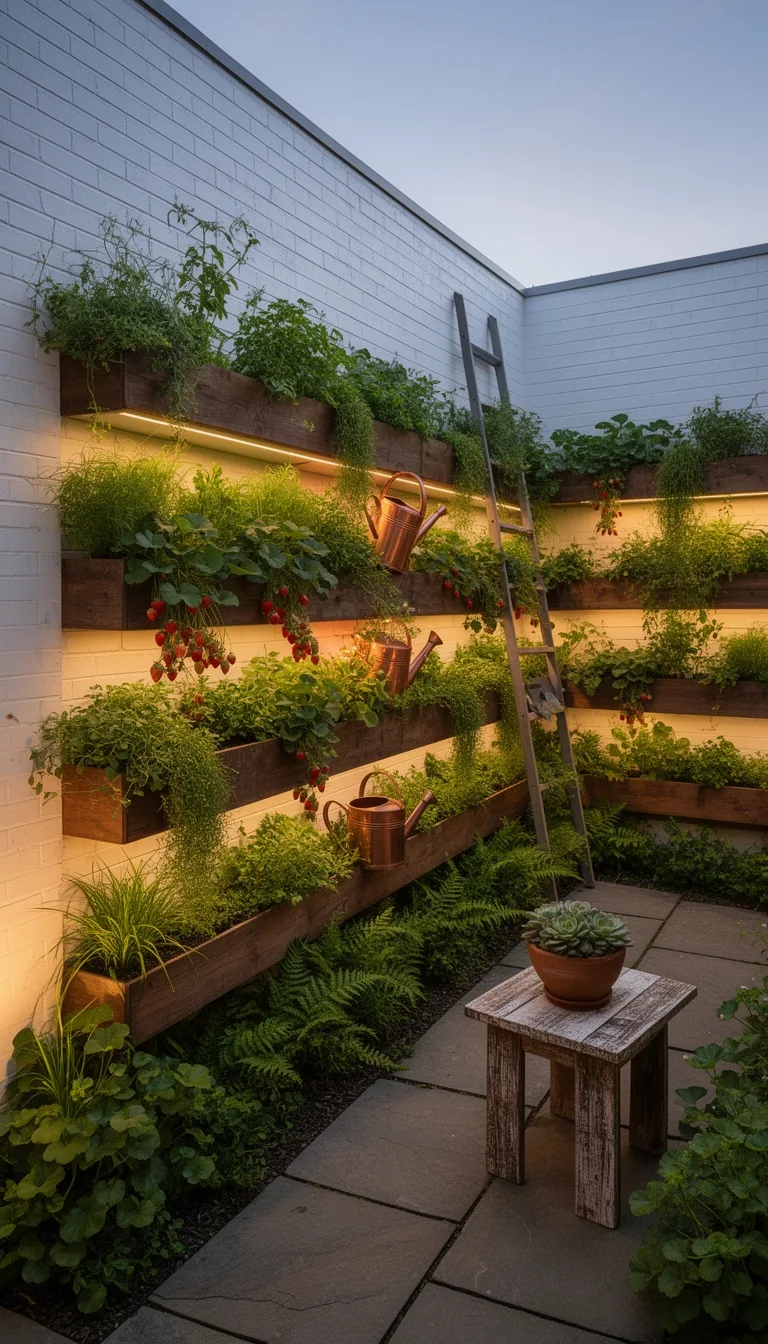
When you’ve maxed out your ground-level garden space, vertical wall planters offer a practical solution that transforms bare surfaces into thriving growing zones.
You’ll benefit from modular systems that adapt to your specific layout, whether you’re working with limited square footage or awkward wall configurations.
Consider these advantages:
- Self-watering mechanisms reduce maintenance while delivering consistent moisture to your plants
- Hydroponic systems maximize growth efficiency and nutrient delivery in compact spaces
- Structural support designs accommodate diverse plant varieties without requiring ivy or green facade installations
- Temperature regulation decreases wall surface temperatures by up to 12°C, cooling surrounding air and reducing energy costs
Wall planters capture rainfall before ground impact, improving local water management.
You’ll also enhance air quality while creating valuable wildlife habitat in your compact outdoor environment.
Install Trellises for Climbing Vines
While wall planters optimize your vertical space with rooted systems, trellises expand your growing capacity by providing lightweight structures that climbing vines use naturally to ascend.
You can build a simple trellis using wire remesh panels secured to ground stakes with zip ties, costing under $20.
For sturdier setups, construct a wood frame from 2×2 pieces connected with decking screws, then attach remesh to the frame’s backside with fasteners spaced every foot.
Wall-mounted trellises require drilling anchor holes, installing hooks, and hanging the structure securely.
For permanent installations, position wooden buttons 30-45 centimeters above ground to prevent rot and drive stakes 12 inches deep for stability.
Build Tiered Plant Stands
Why settle for a single-level plant display when you can build a tiered stand that maximizes your growing space?
You’ll construct a sturdy frame using 2×4 lumber for legs and supports, cutting them to 36-44″ heights.
Attach shelves at varying depths—34″ wide on the bottom tier, 13″ deep in the middle, and 9″ deep on top. Use pocket hole joinery with 1¼” screws and wood glue for secure connections.
- Cut mitered angles on front posts at 22.5° for aesthetic appeal
- Space shelves 8-22¾” apart vertically to accommodate different plant heights
- Add X braces for structural stability and visual interest
- Install 4 casters on the base for mobility around your garden
Cedar construction resists outdoor rot and weather damage effectively.
Hang Planters and Baskets for Year-Round Color
Hanging planters and baskets transform underutilized vertical space into productive growing areas, allowing you to cultivate year-round color without sacrificing precious ground real estate.
You’ll position plants at eye level, eliminating the need for kneeling during planting and maintenance tasks—particularly beneficial if you have reduced flexibility.
The elevated placement naturally deters ground-level pests like slugs, snails, and larger mammals such as rabbits and deer.
However, suspended containers require more frequent attention. Their smaller soil volume and increased air exposure cause faster drying, demanding regular watering and nutrient replenishment.
Larger baskets with greater water retention reduce maintenance frequency.
Consider drainage implications for surfaces below, and select container sizes strategically to match your available care capacity and seasonal conditions.
Choose Compact Plants and Columnar Trees
Maximizing vertical space with hanging planters sets the stage for another layer of efficiency: choosing plants that won’t outgrow your garden’s footprint.
You’ll find that compact varieties and columnar trees deliver substantial visual impact while respecting spatial constraints.
Dwarf shrubs like Pittosporum ‘Golf Ball’ and Westringia ‘Grey Box’ reach just 3 feet, requiring minimal pruning.
Compact perennials such as Anouk Deluxe Lavender stay under 14 inches while flowering prolifically.
Columnar trees—Sky Pencil Holly, Taylors Juniper, and Tiny Tower Cypress—provide vertical interest without lateral sprawl, ideal for narrow borders.
- Dwarf fruit trees like Blushing Delight™ Columnar Apple yield 10 feet height with only 2 feet width
- Ornamental grasses and succulents demand minimal maintenance and water
- Narrow profiles fit planters, maximizing tiny yard potential
- Low-maintenance selections reduce pruning obligations significantly
Select Shade-Tolerant Plants for Problem Corners
Where do you turn when your garden’s darkest corners resist sun-loving plants? Shade-tolerant perennials solve this challenge effectively.
Astilbe thrives in zones 4-8, producing vibrant summer plumes above ferny foliage in partial shade with moist, rich soil.
Coral bells offer bold foliage colors ranging from lemon yellow to deep burgundy while tolerating shade exceptionally well.
Hellebore performs across zones 4-9, blooming winter through spring with cup-shaped flowers and evergreen foliage in well-drained soil.
For structural interest, consider Mahonia—a tough evergreen shrub featuring holly-like leaves and yellow blooms that flourishes in dry shade.
Boxwood Sprinter provides evergreen coverage resistant to deer and boxwood blight in zones 5-9.
Annual options like Impatiens Rockapulco produce masses of blooms even in deep shade, ensuring continuous color through frost.
Layer Seasons With Year-Round Blooming Plants
Once you’ve filled those shadowy corners with reliable perennials, you can build on that foundation by layering plants that’ll keep your garden ablaze with color from spring through the first hard frost.
Strategic layering extends your blooming season by combining plants with overlapping flowering periods. You’ll create continuous color by pairing spring transitional bloomers like balloon flower with summer stalwarts such as coreopsis and Russian sage.
Then layer in fall performers like chrysanthemum and sedum to maintain visual interest as temperatures drop.
- Hardy geranium ‘Rosanne’ delivers violet-blue flowers from late spring through frost
- Dwarf echinacea cultivars produce vivid cone-shaped blooms throughout summer
- Salvia Neosa refloors in fall after mid-summer trimming
- Coreopsis extends blooms into autumn months
This tiered approach maximizes color density while minimizing maintenance demands in compact spaces.
Train Fruit Trees as Espaliers and Cordons
How can you maximize fruit production in a small garden?
Train fruit trees as espaliers or cordons.
These techniques control tree size while boosting yield dramatically.
You’ll start with one-year-old whips on dwarfing rootstocks.
For cordons, plant at 45 degrees and select opposite branches 2-3 feet above ground, tying them horizontally to wires.
For espaliers, choose two opposite shoots, grow them at 40 degrees initially, then lower them horizontally in late summer.
Both methods require consistent maintenance.
Use the modified Lorette system: shorten summer laterals to 2-3 leaves, promoting fruiting spurs.
Space espalier tiers 11-12 inches apart on trellises with bamboo canes for support.
Apples, pears, and quinces work best for cordons; add plums and cherries for espaliers.
This approach yields abundant fruit within minimal footprint.
Build Raised Beds for Accessible Gardening
Raised beds transform gardening by giving you complete control over your soil quality, drainage, and growing conditions without spending years amending compacted ground.
You’ll experience faster soil warming—3-4 weeks ahead of ground level—enabling earlier spring planting and extended fall harvests.
The elevated structure minimizes bending and kneeling, reducing physical strain while making maintenance easier.
- Customize soil composition tailored to specific crop requirements
- Achieve superior drainage that prevents root rot and waterlogging
- Space plants closer together using vertical growth and trellises
- Reduce weed infiltration and pest damage from ground-dwelling insects
A 4’x8′ raised bed generates yields comparable to significantly larger in‑ground areas.
You’ll construct beds from wood, bricks, or recycled materials, positioning them strategically for optimal sun exposure.
Raised beds function as intentional landscape features while maximizing your productive growing space.
Grow Shallow-Rooted Vegetables in Containers
Container gardening offers an ideal solution when you’re working with limited space or shallow soil conditions. You’ll maximize yields by selecting vegetables with minimal root systems that thrive in compact depths.
| Vegetable | Depth Required |
|---|---|
| Radishes | 4-6 inches |
| Asian Greens | 4-6 inches |
| Spinach | 6-8 inches |
| Swiss Chard | 6-10 inches |
Most shallow-rooted crops flourish in slightly acidic to neutral soil (pH 5.5-7.0) under full sun to partial shade. You’ll achieve faster maturation cycles—microgreens harvest in just 7-10 days, while baby lettuces regrow after cutting. Plant radish varieties like Cherry Belle or French Breakfast for quick results. Position containers in areas receiving adequate sunlight, and maintain consistent moisture without waterlogging. This approach eliminates deep-digging limitations while producing nutrient-dense harvests year-round.
Combine Vegetables and Flowers in Potager Beds
While container gardening maximizes yields in shallow soil, potager beds elevate your growing space into an ornamental kitchen garden that combines edibles and flowers in visually striking layouts.
You’ll design geometric patterns with raised beds and pathways that organize your plants into functional art.
Strategic companion planting enhances growth—basil near tomatoes improves flavor, while marigolds repel whiteflies naturally.
Intermingling vegetables with ornamentals confuses pests and reduces pesticide needs through ecological balance.
- Kale, rainbow chard, and cabbage paired with nasturtiums and calendula create vibrant color contrasts
- Edible flowers attract pollinators while adding visual interest between harvests
- Herbs interplanted among vegetables provide year-round textural variety
- Trellises and vertical elements maximize productivity in compact spaces
Your potager becomes both productive and beautiful.
Design Multi-Functional Seating With Storage
Your ornamental garden needs more than just visual appeal—it requires functional spaces where you’ll actually spend time enjoying it.
Multi-functional seating with integrated storage solves this challenge efficiently.
Consider modular sofas that you’ll reconfigure for parties or intimate gatherings, or storage benches that simultaneously provide seating and hold cushions, blankets, and garden tools.
Water-resistant resin deck boxes with cushioned closing mechanisms protect pool accessories while doubling as extra seating.
Mainstay storage coffee tables combine chic design with practical capacity for outdoor games and accessories.
For vertical optimization, install wall-mounted storage cabinets on garage sides or integrate storage into pergola structures.
Built-in drawers beneath outdoor kitchen seating maintain streamlined layouts while keeping essentials organized and accessible, maximizing your compact garden’s usable space without consuming valuable ground area.
Convert Fire Pits Into Dining Tables
If you’re working with limited patio space, converting a fire pit into a dual-purpose dining table combines two essential outdoor features into one compact unit.
You’ll start with a wicker or wooden table from secondhand sources, then drill a center hole sized for standard umbrella poles.
Install a propane gas fire pit kit with a five-gallon tank stored underneath, connecting hoses discreetly. Apply weather-resistant paint and add lava rocks over the burner for visual appeal.
- Glass or hinged lids create a flat dining surface, hiding flames when you’re eating
- Propane systems deliver substantial heat without taking up additional yard space
- Removable covers protect against weather damage between uses
- Round or rectangular designs accommodate different patio dimensions
This conversion maximizes functionality while maintaining an organized, streamlined outdoor area.
Replace Lawn With Patios or Ground Cover
How much of your yard actually gets used? Most homeowners waste significant space maintaining unused lawn. Replace it with a functional patio instead. You’ll reclaim valuable square footage for entertaining, dining, or relaxation.
For a six-person gathering area, plan 150-180 square feet using dimensions like 10’x15′ or 12’x15′.
Consider your region’s preferred materials. Poured concrete dominates most areas for durability and affordability.
Brick pavers offer classic appeal in the Mid-Atlantic. New England homeowners often blend concrete, natural stone, and pavers for visual interest.
If you can’t justify a full patio, install low-maintenance ground cover alternatives like decorative gravel or permeable pavers.
Both reduce mowing requirements while providing defined spaces. Incorporate a 1-2% slope for proper drainage.
This approach transforms underutilized lawn into intentional, functional outdoor living zones.
Pair Pavers With Creeping Plants
While pavers create functional outdoor spaces, they’ll look stark without softening elements—that’s where creeping plants come in.
You’ll soften hard lines and establish a unified, natural aesthetic by integrating low-growing plants between gaps.
Select species matching your site conditions: creeping thyme for sun, dwarf mondo grass or baby’s tears for shade.
These plants establish dense, weed-suppressing coverage while tolerating foot traffic and compacted soil.
- Creeping thyme provides fragrance and green foliage in full sun conditions
- Sedum varieties offer drought tolerance and varied heights from 2-12 inches
- Dwarf mondo grass delivers uniform coverage in shaded areas, requiring minimal maintenance
- Baby’s tears thrives in consistently moist, shaded environments with delicate texture
Prepare gaps at least 2 inches wide with 6 inches of loose, nutrient-rich soil.
Water consistently until establishment.
You’ll achieve durable, low-maintenance pathways with enhanced visual appeal and improved drainage.
Use Gravel for Low-Maintenance Style
Gravel transforms your garden into a virtually maintenance‑free landscape that’ll save you countless hours of upkeep. Unlike grass lawns, gravel requires no mowing, watering, or chemical treatments—occasional raking keeps it looking sharp.
The permeable surface filters water effectively, preventing flooding while enhancing groundwater replenishment through slow infiltration.
You’ll appreciate gravel’s durability in harsh weather conditions and heavy foot traffic without degradation.
Its weight stabilizes erosion‑prone slopes, while the aggregate mulch substrate naturally resists weed invasion.
Gravel absorbs heat, keeping soil cooler and retaining moisture for healthier plant roots.
Design flexibility lets you choose from various colors and textures for rustic or modern aesthetics.
Combine gravel with drought‑tolerant plants, succulents, or linear paving to maximize your small space efficiently while supporting pollinators and native ecosystems.
Define Zones to Make Spaces Feel Larger
Why does dividing your backyard into distinct zones make it feel more spacious than one open expanse? Strategic segmentation creates visual interest and depth perception, transforming cramped yards into multifunctional retreats.
You’ll maximize your garden’s potential by establishing purposeful areas:
- Assign defined zones like sunbathing decks, dining pergolas, or herb gardens to give each space intentional function
- Use tiered divisions with raised beds and terraces that step into garden pockets, boosting perceived size through elevation changes
- Employ vertical screening via trellises, pleached trees, or ornamental grasses to delineate boundaries while maintaining light penetration
- Create pathways through arches and pergolas linking zones, establishing sight lines that draw the eye deeper into your garden
This zoning approach prevents you from viewing everything simultaneously, enhancing discovery and making limited square footage feel substantially larger.
Disguise Edges With Dense Plantings
How can you transform your garden’s perimeter from an obvious boundary into an extension of your landscape?
You’ll disguise hard edges through dense plantings that blur the distinction between your garden and surroundings.
Layer shrubs, ornamental grasses, and groundcovers at varying heights to create visual depth while concealing property lines.
This graduated approach makes confined spaces appear more expansive by directing attention inward rather than toward boundaries.
Strategic layering also adds textural complexity without cluttering your design.
Combine plants with different foliage patterns—fine-textured grasses with bold-leafed shrubs—to establish visual interest while maintaining spatial cohesion.
Dense arrangements along borders eliminate cramped-looking hard lines, making your small backyard feel open and intentionally designed rather than confined.
Add Focal Points Without Taking Space
Small gardens demand focal points that captivate the eye without consuming valuable ground space.
You can strategically layer vertical and architectural elements to draw attention while maximizing your layout efficiency.
- Elevated containers: Position glazed ceramic urns on pedestals at pathway corners to command eye-level prominence without ground footprint
- Water features: Install wall-mounted fountains or small-scale basins that attract via movement and sound while preserving planting areas
- Vertical installations: Deploy climbing clematis or ivy across boundaries, or mount herb gardens directly on walls to expand perceived space
- Sculptural anchors: Place simple obelisk structures within formal beds to create visual resting spots that ground your design scheme
These stratified focal points guide exploration through compact areas, creating layered depth and visual interest without sacrificing the functional ground space your garden requires.
Use Outdoor Rugs to Define Areas
While vertical elements and sculptural anchors establish visual interest in compact gardens, outdoor rugs accomplish something equally powerful on the ground plane: they carve distinct functional zones into open spaces without requiring permanent structures.
You can place a rectangular rug beneath your dining table to mark the meal area, or position a round rug under lounge chairs to define a relaxation zone.
Runner rugs along garden pathways visually guide guests toward seating nooks or fire pits, creating intuitive navigation throughout your patio.
This zoning technique transforms multi-purpose spaces into organized, purposeful areas.
Choose fade-resistant, weather-durable materials like polypropylene that withstand UV exposure and foot traffic while maintaining vibrancy.
Color choices harmonize with existing hardscaping and plantings, establishing cohesion while protecting underlying surfaces from wear.
Keep Visual Clutter Minimal With Repeat Plants
After you’ve carved out distinct zones with rugs and vertical elements, repetition becomes your most powerful tool for visual coherence.
Repeating plants throughout your compact garden eliminates visual fragmentation while generating structure and winter interest.
Strategic repetition ties disparate areas together—linking your deck to walkway-facing beds with shared foundation plants creates unified flow.
You’ll achieve this cohesion by selecting 5-7 anchor plants (siberian iris, hardy geraniums, hostas, daylilies) and distributing them across multiple zones rather than scattering one-of-each specimens.
Choose repeater plants with these qualities:
- Thrive in both sun and shade conditions
- Display dense, shapely habits for strong visual form
- Divide easily for cost-effective propagation
- Feature pale or subtle flowers that avoid dominance
This approach maximizes your small space’s apparent size while maintaining sophisticated, uncluttered aesthetics.
Add Green Roofs to Sheds
Once you’ve maximized your ground-level planting with strategic repetition, you’ll want to look upward—your shed roof offers untapped vertical real estate for an extended green garden.
Start by confirming your roof’s structural integrity and waterproofing.
Install a robust waterproof membrane like EPDM, then add a geotextile fleece layer for protection.
Create proper drainage with a green roof membrane featuring cavities, positioned over drain boxes.
Elevate modular planted trays ½ inch above the roof surface using built-in feet.
Install sedum cassettes in rows, interlocking trays perpendicularly for stability.
Fill edges with gravel, then water and fertilize.
Secure aluminum edging at least 18 inches from roof edges with exterior-grade screws.
Clear spilled material immediately to protect the membrane.
Choose Fast-Cropping Varieties for Quick Harvests
Why wait months for your garden to produce when you can harvest vegetables in weeks?
You’ll maximize your small space by selecting fast-cropping varieties that deliver rapid yields.
Cress reaches harvestable maturity in just 15 days, while radishes mature within 21 days.
Asian greens like Mizuna and Tatsoi produce pickable leaves in approximately 21 days.
These quick-turnaround crops allow you to succession plant throughout the season, ensuring continuous harvests.
- Leafy greens: Cress (15 days), Arugula (25-35 days), Spinach (30 days)
- Root vegetables: Radishes (21 days), Turnips (30-35 days), Green onions (30 days)
- Brassicas: Mustard greens (21-30 days), Kale baby leaves (30 days), Bok Choy (25 days)
- Fruiting crops: Summer squash (45-50 days), Pickling cucumbers (50-58 days)
Conclusion
You’re essentially building a puzzle where every square inch counts. Think of your small garden like a Tetris game—you can’t just stack pieces randomly and expect them to fit. By layering vertical planters, angling hardscaping, and choosing compact crops, you’re strategically interlocking each element. Studies show gardeners who implement these space-saving techniques harvest 40% more yield from half the footprint. Your tiny backyard transforms into a productive, visually cohesive outdoor room when you prioritize smart spatial planning.
The Only Tools You Need for a Thriving Garden 🌱
Whether you're a weekend gardener or growing daily — these hand-picked tools make every session faster, easier, and more satisfying.